Introduction
The oldest reference about the one hundred churches of Chora Sfakion that one can find is the epic poem of the Daskalogiannis uprising of 1770, where, following the uprising’s bloody suppression by the Turks, the poet laments:
“Where is now Chora Sfakion with its many boats,
With its one hundred churches, its wealthy houses?
Mesochori, Omprosgialos, Tholos, Giorgitsi?
All of them have been destroyed, one cannot recognise even a house...”
This story of the destruction of the one hundred churches has been repeated many times over the years, by both locals and historians, and has become one of the strong local traditions of Chora Sfakion. I heard this story also when I firstly started coming to Sfakia where my own roots come from. I was interested in the history of this area and also in photography, so I started walking around the village looking for the churches or the ruins of any that one can find photographing them and learning as much as there was about them.
I talked with many locals, I looked into libraries for any historical information that I could find and so what started as a pastime during my first regular holiday visits culminated in a decision to research the legend and write a book for the benefit of the locals who are interested in their history and traditions and especially the younger generation.
In researching the legend, and in the presentation of the results in this book, I have taken two distinctly different approaches, although parallel to each other. The one was to try and located as many churches, or ruins of churches, by talking with the locals and walking around the village and photographing those that I located. I also took GPS readings of their locations to enable me to map them for future reference. The second approach was to do some research in libraries and other archives in order to locate any information that might have existed on the topic of churches in Chora Sfakion, from the earliest possible written material to the latest historical research and other data sources.
The book is divided into the following sections:
Prologue and Introduction |
pages 1–7 |
Presentation of the churches of Chora Sfakion |
pages 9-80 |
Research findings from historical and other data sources |
pages 82-99 |
Conclusion |
pages 100-103 |
Maps, GPS location tables, Bibliography |
pages 107-113 |
Presentation of the churches of Chora Sfakion
pages 9-80
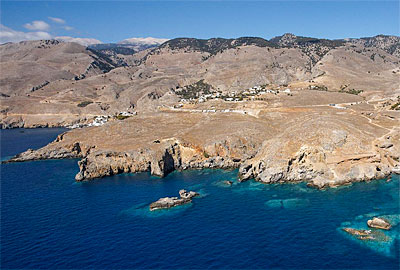
The churches are presented in the book as a visitor to Chora Sfakion will see them if he was to come off the ferry boat and start strolling through the village. Pages 9 to 11 provide a brief introduction to Chora Sfakion, and its four quarters, Omprosgialos, lower down by the sea (Ompros Gialos means before the shore), Mesochori (middle village) further up and towards the east, Tholos (dome) further to the east, above the eastern harbour and Giorgitsi (name derived most probably from the chapel of Saint George), high up the mountain, above Omprosgialos and Mesochori. This section also provides a brief description of the architectural style of the churches.
The churches that are presented are: (download Google Earth map with all churches)
Omprosgialos
Panagia (Holy mother) pages 11-12
This is a new church, built after WWII when the 17th century old church was
destroyed during the bombardment of Chora Sfakion in May 1941
-
Agia Varvara (Saint Barbara) page 12
This is a new church, built in 1934 on the location of an older, 15th or 16th century church
Agios Panteleimon and Agios Nikolaos (Saint Panteleimon, “the all-compassionate” and Saint Nicholas) pages 13-14
These two churches form the main parish church, the first having been built in
the 17th or 18th century and the second having been built in 1817
-
Christos (Christ), ruined church page 15
This is possibly a Venetian era church (15th to 16th centuries)
Zoodochos Pigi (Life giving spring) page 15
This is a new building covering an older cave church, similar to the one that is adjacent to it
-
Agios Eleftherios, ruined cave church page 16
This is an old cave church where the front building has collapsed and is ruins
Agios Spyridonas page 16
This is a new church, built in 1993 in the place of an older, possibly 18th century, church. Tradition has it that in this place there was a grave of a hero of the 1821 uprising, for whom a monument was recently raised in 2001
Agios Georgios page 17
This relatively new church was built on the location of an older church that was the
front of a cave church
Agia Paraskevi, abandoned cave church page18
Agios Antonios, church in cave page 19
This is a Venetian era church (15th to 16th centuries) that is mentioned in the 1637
census of churches conducted by the Venetians
Agios Ioannis Theologos page 20
This is also a Venetian era church (15th to 16th centuries) that appears in a 17th century
drawing of the village. This was rebuilt in the 1800’s according to local sources
Mesochori
-
Panagia (Holy mother) page 21
This is a 15th century church that was rebuilt in 1958. It appears in the 1637 census
of churches conducted by the Venetians
Agios Constantinos and Agia Eleni page 22
This is also a 15th century that appears in the 1637 census of churches conducted by the Venetians. It was recently restored and reopened in 2007
Agion Panton (All Saints) page 23-28
This is also a 15th century that appears in the 1637 census of churches. It contains
some frescoes from the 16th century that are unique in that they contain two presentations
each within a 60 cm x 60 cm border with writing in the local Sfakian dialect. The southern part
of the church must have collapsed some time in the 17th century and rebuilt
Christou and Panagias pages 29-31
This church consists of two buildings, the first having been built in the 16th or 17th
century, while the second was built on the south side of the first one in 1839. The
first appears in the 1637 census of churches conducted by the Venetians
Agios Ioannis Rigologos page 32
This is a 16th or 17th century church that was recently renovated
Agios Nikolaos, ruined church page 33
There is no local information available about this ruined church
Agion Anargyron, ruins only and iconostasi page 34
This church appears in a 1435 documented agreement between two local families
regarding respective property boundaries and must have been built a few years earlier in
that century
© Wolfgang Kistler
Profitis Ilias page 35
Similarly with the above church, this also appears in the 1435 agreement between two
local families regarding respective property boundaries and must have been built a few
years earlier in that century
Timios Stavros (Holy Cross) page 36
This is a 17th century church that has been renovated recently. It also appears in the
1637 census of churches
Tholos
Agion Apostolon (Holy Apostles) pages 37-40
This church also appears in the 1435 agreement between two local families regarding
respective property boundaries and must have been built a few years earlier in that
century. It is in danger of collapsing as it did some time in the middle of the previous
century when it was rebuilt by a local priest
© Erno Verhoeven
Ypapantis tou Sotiros (Presentation of Christ) pages 41-42
This is a 15th or 16th century church that appeared in the 1637 census of churches
Agiou Ioanni Prodromou and Agiou Ioanni Theologou page 43
Similarly, the first at least is a 15th or 16th century church that appeared in the 1637
census of churches
Agios Athanasios, ruins only and iconostasi page 44
The ruins belong possibly to a church built in the 15th or 16th century and which appears
in a 17th century drawing of the village
Agios Georgios page 45
Probably this is a 18th or 19th century church, but no relevant information is available
Agios Georgios page 46
Similarly this is a 18th or 19th century church, but no relevant information is available
Panagia (Holy mother) page 47
Again, this is a 18th or 19th century church, but no relevant information is available
Giorgitsi
Agios Georgios pages 49-50
This is a 15th century church that appeared in the 1637 census of churches
Panagia (Holy mother), ruins pages 51-53
This is also a 15th century church and it is possible that it was included in the 1637
census as the church of Agios Georgios, as there are two churches of Agios Georgios
in Giorgitsi that appear in the census
Christos (Christ) , ruined church pages 54-55
This also is a 15th century church that appeared in the 1637 census of churches
Agia Paraskevi pages 57-58
This most probably is a 15th or 16th century church and appears in the 1637 census
Agios Nikolaos, ruins page 58
Probably this is a 17th century church as it does not appear in the 16th century drawings
of the village or the 1637 census
Panagia (Holy mother) page 60
This is a 16th or 17th century church, recently renovated
Agia Paraskevi, abandoned cave church page 61
Nothing much is known about this church
Others located outside the Village
Agia Triada (Holy Trinity) pages 62-63
This is most probably a 17th century church that appears in some of the drawings
of the village from early in the 18th century and also in included in the 1637 census
Agia Kyriaki, abandoned cave church pages 64-65
Very little is known about this cave church other than some ruins were located
there by a researcher in about 1969-70
Agios Charalampos, cave church pages 66-67
The building enclosing this cave church was most probably built in the 19th or
early 20th centuries. Nothing much is known locally about it
© Wolfgang Kistler
Churches located in the summer villages of Chora Sfakion,
Mouri and Kaloi Lakkoi
Christou and Panagias, Mouri pages 69-71
These two churches were built at different times, the first on the northern side
in the 19th century while the one on the south side in 1859
Agios Georgios, Kavros, Mouri page 72
This is most probably a 16th or 17th century church
Agios Nektarios, Katsoura, Mouri page 73
This is a most recent construction by the Mpraoudakis family
-
Timios Stavros (Holy Cross), Kavis gorge, Mouri page 74-77
This is one of the oldest churches in the area, dating from the 14th century but has
almost been destroyed by the elements. The river bed has moved over the centuries
and has surrounded the church that has suffered lately from frequent flooding and is
now partially submerged in the river bed
Agios Pavlos (Saint Paul), Dichalomata, Kaloi Lakkoi pages 78-80
This is the fourth church that appears in the 1435 agreement between the two
local families regarding respective property boundaries. It must have been built
some time before that date.
© Simon Stutz
Note: With each of the churches above I have presented only a very brief indication about their age and some other basic information. In the book there is some more information that relates to their history, where such was possible to identify. This additional information has not been provided above as it was beyond the purpose of providing a summary translation only.
Research findings from historical and other data sources
pages 82-99
The second part of this research involved the study of historical records and other relevant material that would have assisted in determining what churches were built in Chora Sfakion and when, as well as any evidence of the complete destruction of churches resulting from the 1770 uprising. This research started by looking at written material from the 14th century and later as there has been no evidence of any churches from the Byzantine era in Chora Sfakion.
Sfakia, until its 1367 destruction by the Venetians in the aftermath of the Kallergis brothers insurrection, had Anopolis as its district capital and most of the wealthy and significant people lived there. Following the bloody suppression of this insurrection the Venetians completely destroyed Anopolis and declared the whole Anopolis plateau out of bounds to all Sfakians and to any rural activity for a period of one hundred years.
The Sfakian historian Papadopetrakis writes that as a result of the above events, Sfakians elected Chora Sfakion to be the new district capital and agreed that all villages of the district and the main families would each built a church in Chora Sfakion so that they could all gather there on the saint’s feast day to which each of the churches was to be dedicated. This way all Sfakians would have the opportunity to gather together on a regular basis and maintain the tight community spirit that had existed previously. Papadopetrakis tells us that as a result 45 churches were built and later on another, the Agioi Apostoloi, was built, taking the total number to 46. Unfortunately he does not give us either the years that this took place or the names and places of all those churches. It must be noted also that he wrote his history in 1878, more than 400 years after the event, so the story of the 46 churches he must have got it from the local oral tradition as he did not refer to any written information source.
The first written evidence that we have is of Cristoforo Buondelmonti, an Italian traveller who travelled around Crete in 1415 and published his travel impressions in his Descriptio insulae Cretae (1417). In his description of Chora Sfakion he laments on the total destruction of the village. He then moves to Anopolis where he observed that the Sfakians did not live there or cultivate the earth because of their fear of the Venetians, having been barred from reoccupying the area about 50 years previously. The second written evidence that we have is a 1435 documented agreement between two local families regarding respective property boundaries. In specifying the boundaries, four churches are given as markers for the border of the property of one of the families. These are the churches with the numbers 42, 21, 18 and finally 19 indicating a property border from Kaloi Lakkoi south to the eastern part of Chora Sfakion and then turning west into the village. This document then indicates that the construction of the 46 churches that Papadopetrakis wrote about must have taken place between 1415 and 1435. (see pages 83-84)
The next document that we have is a census of all churches undertaken by the Venetians in the years 1634 to 1637. The census was based on data provided by the priests of Chora Sfakion and provides records of 16 churches only. There is a view amongst researchers that the census reflects some reluctance on behalf of the priests and the owners of the churches to provide full data to the Venetian authorities in case this would have resulted in taxes or other impositions. (see pages 84-87) Examination of writings by visitors to Crete during the period 1553 to 1792 (22 years after the destruction of Chora Sfakion) did not reveal any information about the churches of the village. Out of the writings examined only two visitors (Dapper, 1688 and Tournefort, 1700) came through the village and neither of them mentions the churches of the village. One would have thought that one hundred churches, if they existed at the time, would have impressed them in this “small village”, as Dapper describes it.
Four drawings, all by Venetians from the early 18th century, were also examined for evidence of a large number of churches. These are presented on pages 90-96. Out of these the first by Basilicata shows somewhere between 3 and 7 churches. The second by Boschini shows clearly 2 churches and another 3-4 buildings that may be churches. The third by Monani shows clearly 6 churches and there is the possibility of a few more within the village buildings. The fourth one that is currently unattributed shows clearly the largest number, 11 churches.
From there the research turned to 20th century writers. Three historians quote the number one hundred; one even makes them to be 105, obviously all the three of them adopting the number of the local tradition as historical fact. Another one quotes the Papadopetrakis number of 45 churches. Finally, a more recent study by the Oxford University, the Sphakia Survey, unfortunately did not cover in detail the area of Chora Sfakion so this also was not of assistance.
Finally the results of a 1991 census by the Greek Statistical service were examined to determine that all churches that were in the census were covered by the book.
Conclusion
pages 100-103
Searching for the one hundred churches in the area did not produce evidence that once there was such a large number of churches in such a small village. What I discovered was evidence of about 30 churches that could have been in the village when it was destroyed in 1770. Searching through the historic records again there was no evidence that the number of the churches at that time was many more than that. Even Papadopetrakis’ claim that 46 churches were built early in the 15th century seems to be rather large, and again is not supported by any historical records. So, on what basis did the poet of the Daskalogiannis epic poem wrote that the village had one hundred churches?
The book then looks at the use of the number one hundred in poetry, in everyday language and in local traditions and concludes that the use of the one hundred was intended to signify a large number, not a specific number of churches. In other words the poet used poetic licence to indicate how rich and prosperous Chora Sfakion was prior to its destruction by the Turks in 1770. So he said in his poem that the village had, amongst other riches, one hundred churches. And that is how, over the years, what started as poetic licence in an epic poem, finished as a local tradition.
Maps, GPS location tables, Bibliography
pages 107-113
The book also includes 3 maps indicating the location of each of the churches covered by the book and also tables indicating the coordinates of each location in both the WGS84 system and the Greek GGRS87 system for anyone that might be interested to visit those churches.
The Bibliography is of mostly Greek language books.
All text and photos Copyright © George Dalidakis unless otherwise stated. All rights reserved.