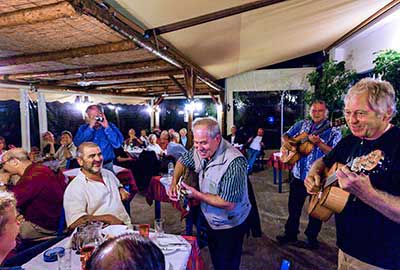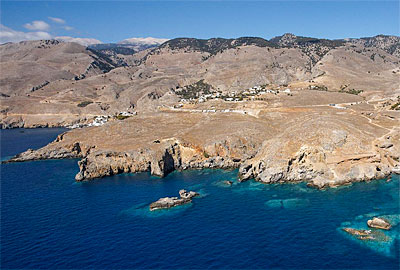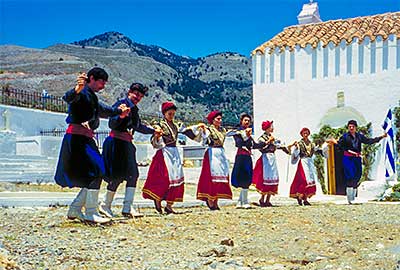


Greek and Cretan Christmas customs
Kala Christouyenna! Merry Christmas!
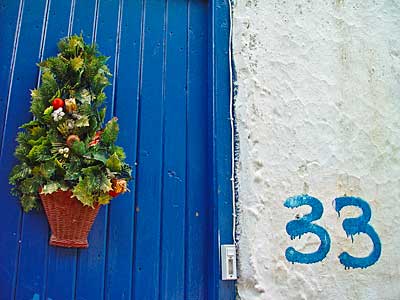
Christmas decoration in Sfakia, Crete
At least 95 percent of all Greeks claim membership in the Greek Orthodox church, part of the Eastern Orthodox church. Until 1054, the Eastern Orthodox and Roman Catholic churches were one body. Theological, political, and cultural differences split the church in two, and those differences were never completely reconciled. Despite the power religion holds over everyday life, Greeks are not devout churchgoers. Aside from the special Easter celebrations, services are attended mainly by old women and young children. And the Greeks often defy their church's teachings by clinging to old 'superstitions' or their own beliefs from cultural heritage.

Religious customs are alive and Christmas, Easter and the Assumption of The Virgin (15th August) are considered to be the greatest of religious feasts. To members of the Eastern Orthodox Church Christmas ranks second to Easter in the roster of important holidays.
| Nativity of the Theotokos | 8 September |
| Exaltation of the Holy Cross | 14 September |
| Presentation of the Theotokos in the Temple | 21 November |
| Christmas (Nativity of Jesus Christ) | 25 December |
| Epiphany (Baptism of Christ) | 6 January |
| Presentation of Christ in the Temple | 2 February |
| Annunciation (Evangelismos) | 25 March |
| Easter (Pascha) | Date varies from year to year |
| Ascension | 40 Days after Easter |
| Pentecost | 50 Days after Easter |
| Transfiguration of Christ | 6 August |
| Dormition of the Theotokos (Kimissis) Assumption of Mary |
15 August |
*) The determination of the date of Easter is governed by a computation based on the vernal equinox (the point at which the ecliptic intersects the celestial equator, the sun having a northerly motion) and the phase of the moon. According to the ruling of the First Ecumenical Synod in 325, Easter Sunday should fall on the Sunday which follows the first full moon after the vernal equinox. If the full moon happens to fall on a Sunday, Easter is observed the following Sunday. The day taken to be the invariable date of the vernal equinox is 21 March.
The Greek Orthodox
Church is celebrating Christmas
on the 25th December,
on the same date as the Catholic and Protestant Churches.
That Greek date for Christmas was picked because on the same day in the Mediterranean area they used to celebrate a Persian god, Mithras, who was the god of the Sun. And, because the difference between light and darkness is such an important aspect of the December month, all our Greek traditions and customs are still based on that contrast of darkness and light.
Christmas tends to be a quiet, solemn, season. In some areas, the holiday is preceded by a time of fasting. For Greece, the season is in full swing by December 6th, the Feast of St. Nicholas when presents are exchanged, and will last through January 6th, the Feast of Epiphany. Nicholas (and every Greek Nikos) have their so called name day on 6th December.
On the day and evening before Christmas and New Year's, children sing the equivalent of carols (kalanda) from house to house. These kalandas bless the house. Often the songs are accompanied by small metal triangles and little clay drums. The children are frequently rewarded with sweets and dried fruits.
The word carol
comes from a Greek dance called a choraulein, which was accompanied
by flute music. The dance later spread throughout Europe and became
especially popular with the French, who replaced the flute music
with singing. People originally performed carols on several occasions
during the year. By the 1600's, carols involved singing only, and
Christmas had become the main holiday for these songs.
St. Basil's Day (New Year's Day) is a time for parties and
gift giving. St. Basil is the Santa Claus of Greeks.
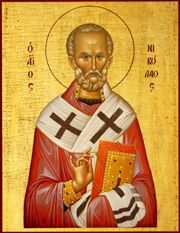
Saint Nicholas
St. Nicholas is important in Greece as the patron saint of sailors. According to Greek tradition, his clothes are drenched with brine, his beard drips with seawater, and his face is covered with perspiration because he has been working hard against the waves to reach sinking ships and rescue them from the angry sea. Greek ships never leave port without some sort of St. Nicholas icon on board.
After
40 days of fasting, the Christmas feast is looked forward to with
great anticipation by adults and children alike. Pigs, lambs and
goats are slaughtered, women usually bake ceremonial pastries during
this time for the big family meal, served after church services
on Christmas Day. Melomakarona are honey-dipped cookies often stuffed
with nuts. Kourambiedes are cookies dusted with powdered sugar and
very white, Diples are fried dough cookies, dipped in honey.
On almost every table are loaves of Christopsomo ("Christ Bread").
It is a round loaf, decorated on the top with a cross, around which
people will also make symbols shaped in dough that represent whatever
it is they do in life. If people live on an island and they're fisherman,
they will decorate the bread with fish. If they have a lamb farm,
you'll see little lambs.
Christmas trees are not commonly used in Greece (but this is changing rapidly). In almost every home the main symbol of the season is a shallow wooden bowl with a piece of wire that is suspended across the rim; from that hangs a sprig of basil wrapped around a wooden cross. A small amount of water is kept in the bowl to keep the basil alive and fresh. Once a day, a family member, usually the mother, dips the cross and basil into some holy water and uses it to sprinkle water in each room of the house. This ritual is believed to keep the Killantzaroi (Kallikantzaroi or Karkantzaroi) away from the house.
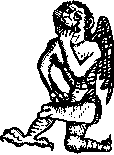
Traditions about the Kallikantzaroi vary from region to region, but in general they are half-animal, half-human monsters, black, hairy, with huge heads, glaring red eyes, goats' or asses' ears, blood-red tongues hanging out, ferocious tusks, monkeys' arms, and long curved nails, and commonly they have the foot of some beast. "From dawn till sunset they hide themselves in dark and dank places .., but at night they issue forth and run wildly to and fro, rending and crushing those who cross their path. Destruction and waste, greed and lust mark their course." When a house is not prepared against their coming, "by chimney and door alike they swarm in, and make havoc of the home; in sheer wanton mischief they overturn and break all the furniture, devour the Christmas pork, befoul all the water and wine and food which remains, and leave the occupants half dead with fright or violence." Many like or far worse pranks do they play, until at the crowing of the third cock they get them away to their dens. The signal for their final departure does not come until the Epiphany, when the "Blessing of the Waters" takes place. Some of the hallowed water is put into vessels, and with these and with incense the priests sometimes make a round of the village, sprinkling the people and their houses.
Besides this ecclesiastical purification there are various Christian precautions against the Kallikantzaroi - e.g., to mark the house-door with a black cross on Christmas Eve, the burning of incense and the invocation of the Trinity - and a number of other means of aversion: the lighting of the Yule (= Christmas time) log, a large log of wood called a skakantzalos, the burning of something that smells strong (sometime the Greeks will also burn old shoes, the smell of which keeps the wicked elves away), and - perhaps as a peace-offering - the hanging of pork-bones, sweetmeats, or sausages in the chimney.
Just as men are sometimes believed to become vampires temporarily during their lifetime, so, according to one stream of tradition, do living men become Kallikantzaroi. In Greece children born at Christmas are thought likely to have this objectionable characteristic as a punishment for their mothers' sin in bearing them at a time sacred to the Mother of God. In Macedonia people who have a "light" guardian angel undergo the hideous transformation.
Many attempts have been made to account for the Kallikantzaroi. Perhaps the most plausible explanation of the outward form, at least, of the uncanny creatures, is the theory connecting them with the masquerades that formed part of the winter festival of Dionysus and are still to be found in Greece at Christmastide. The hideous bestial shapes, the noise and riot, may well have seemed demoniacal to simple people slightly "elevated," perhaps, by Christmas feasting, while the human nature of the maskers was not altogether forgotten. Another theory of an even more prosaic character has been propounded that the Kallikantzaroi are nothing more than established nightmares, limited like indigestion to the twelve days of feasting. This view is taken by Allatius, who says that a Kallikantzaros has all the characteristics of nightmare, rampaging abroad and jumping on men's shoulders, then leaving them half senseless on the ground."
Such theories are ingenious and suggestive, and may be true to a certain degree, but they hardly cover all the facts. It is possible that the Kallikantzaroi may have some connection with the departed; they certainly appear akin to the modern Greek and Slavonic vampire, "a corpse imbued with a kind of half-life," and with eyes gleaming like live coals. They are, however, even more closely related to the werewolf, a man who is supposed to change into a wolf and go about ravening. It is to be noted that "man-wolves" is the very name given to the Kallikantzaroi in southern Greece, and that the word Kallikantzaros itself has been conjecturally derived by Bernhard Schmidt from two Turkish words meaning "black" and "werewolf." The connection between Christmas and werewolves is not confined to Greece. According to a belief not yet extinct in the north and east of Germany, even where the real animals have long ago been extirpated, children born during the Twelve Nights become werewolves, while in Livonia and Poland that period is the special season for the werewolf's ravenings.
Those who wish to pursue further the study of the Kallikantzaroi should read the elaborate and fascinating, if not altogether convincing, theories of Mr. J. C. Lawson in his "Modern Greek Folklore and Ancient Greek Religion." He distinguishes two classes of Kallikantzaroi, one of which he identifies with ordinary werewolves, while the other is the type of hairy, clawed demons above described. He sets forth a most ingenious hypothesis connecting them with the Centaurs.
Excerpted from Christmas in Ritual and Tradition, Christian and Pagan, by Clement A. Miles, London: T. Fisher Unwin, 2nd Ed. 1913, pp. 229-247.
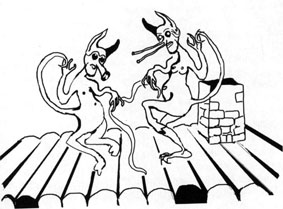
There are a number of beliefs connected with the Killantzaroi, who appear only during the 12-day period from Christmas to the Epiphany (January 6). These creatures are believed to emerge from the center of the earth and to slip into people's house through the chimney. The fireplace is kept burning day and night throughout the twelve days, to keep the spirits from entering by the chimney, a curious inversion of the visit of Santa Claus and Saint Nicolas in other countries! By the way, these two are not the same:
The original Santa Claus, St. Nicholas, was born in Turkey in the 4th century. He was very pious from an early age, devoting his life to Christianity. He became widely known for his generosity for the poor. But the Romans held him in contempt. He was imprisoned and tortured. But when Constantine became emperor of Rome, he allowed Nicholas to go free. Constantine became a Christian and convened the Council of Nicaea in 325. Nicholas was a delegate to the council. He is especially noted for his love of children and for his generosity for them. He is the patron saint of sailors in Sicily, Greece, and Russia. He is also, of course, the patron saint of children. The Dutch kept the legend of St. Nicholas alive. In 16th century Holland, Dutch children would place their wooden shoes by the hearth in hopes that they would be filled with a treat. This custom is still alive, without the wooden shoes that is, and is celebrated on the evening of December 5, the night before St. Nicholas' birthday on the 6th, when both children and adults exchange presents. The Dutch spelled St. Nicholas as Sint Nikolaas, which became corrupted to Sinterklaas, and finally, in Anglican, to Santa Claus. In 1822, Clement C. Moore composed his famous poem, "A Visit from St. Nick," which was later published as "The Night Before Christmas." Moore is credited with creating the modern image of Santa Claus as a jolly fat man in a red suit. Note the difference of St. Nicholas and his celebration on December 5 and Santa Claus, who now is connected to Christmas, December 25. Both are dressed in red and have a white beard. St. Nicholas is dressed like a bishop and comes on a gray horse and has nothing to do with reindeer. Now it's told he comes from Spain.
Santa Claus gives way to Saint Basil: gifts are exchanged on St. Basil's Day (January 1). On this day the "renewal of waters" also takes place, a ritual in which all water jugs in the house are emptied and refilled with new "St. Basil's Water." The ceremony is often accompanied by offerings to the naiads, spirits of springs and fountains.
In the Western Church, Epiphany (6th of January) is dedicated to the commemoration of three events: (1) the baptism of Jesus; (2) the visit of the Wisemen to Bethlehem, and (3) the miracle of Cana (the changing of the water into wine), by which the Western Church celebrated the manifestation of Christ to the world and His power to perform miracles. In the Orthodox Church, the Nativity, after being introduced from the West, was designated to be observed also on December 25th, probably by the heretic Arians in Antioch. This happened about fifty years after Epiphany, the anniversary of the baptism of Jesus Christ, was designated. In fact, St. Basil and St. Gregory had attempted to differentiate between the two celebrations by imposing the name "Theophany" on the Birth of Christ, December 25th, and keeping the name "Epiphany" for the celebration on the 6th of January. However, they were unsuccessful.
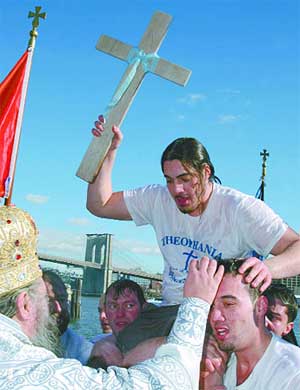
The Greek Festival of Epiphany, or 'The Blessing of the Waters', is held every year on January 6 throughout all of Greece. This is the special occasion when many daring young Greek men brave the chilly waters to dive for a cross after it has been blessed by a priest and thrown into the water. For his gallantry, the first man who recovers the cross is said to have good luck throughout the coming year. The day long festival also features the blessing of small boats and ships, and later on affords entertainment, music, dancing and food to all those present.
Xmas: This abbreviation for Christmas is of Greek origin. The word for Christ in Greek is Xristos. During the 16th century, Europeans began using the first initial of Christ's name, "X" in place of the word Christ in Christmas as a shorthand form of the word. Although the early Christians understood that X stood for Christ's name, later Christians who did not understand the Greek language mistook "Xmas" as a sign of disrespect.
Modern Greek Christmas
Christmas was never considered much of a holiday in Greece compared with Easter, but things have slowly changed and now it has become a much cherished celebration. The traditions have become simplified, but still Christopsomo bread is served at the big Christmas meal. Many people deplore the secularization of Christmas. For instance, now you'll find Christmas in Greece celebrated with lavish decorations and lights strung across most of the streets in major cities and towns. Athens in particular has responded to the revival of Christmas where its former flamboyant mayor, Dimitris Avramopoulos, has added new colour to the festivities by erecting the largest Christmas tree in Europe.
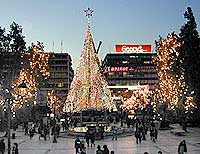
December 1st, 2005 - Christmas cheer
Athens Mayor Dora Bakoyannis yesterday announced the program of Christmas events for the city center, which is to open on December 15 when the lights on the Christmas tree in Syntagma Square will be switched on. This year's Christmas program will include a «Gift City» at Kotzia Square, an ice rink at the Zappeion Mansion and carousels at Omonia Square, Bakoyannis said. A total of 1.3 million euros is being spent on this year's festivities, she said.
CHRISTMAS COUNTDOWN - December 5, 2006
City of Athens to spend 1.5 million euros on events for festive season
The City of Athens will spend 1.5 million euros on decorating the city center and organizing events for Christmas, Athens Mayor Theodoros Behrakis said yesterday. The outgoing mayor said that the lights on the Christmas tree in Syntagma Square will be switched on in nine days. A 120-year-old carousel will also be set up in the square for children to ride. A smaller carousel will operate in Kotzia Square from December 16. A giant snowman in front of Zappeion Hall will house the “workshop of fun,” Behrakis said. The municipality has also organized three New Year’s Eve concerts at Syntagma, Kotzia and Klafthmonos squares.
Yuletide joy - 6 December, 2007
Christmas festivities in Athens, including open-air concerts and other cultural events, are to begin on December 13 and continue until January 6, City Hall officials said yesterday. Central Syntagma Square will be the focus of most activities while the National Garden will be transformed into a «magical village» with guides dressed as elves showing visitors around, officials said. Activities are also planned for several other squares including Omonia, Karaiskaki and at the Panathenaic Stadium.
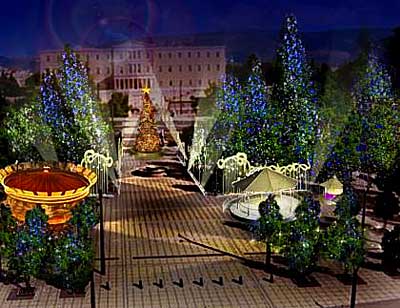
Christmas on Syntagma Square, Athens 2007
Christmas tree brings glitz to capital - 14 December, 2009
A couple embraces under the Christmas tree in Syntagma Square after a lighting ceremony on Friday. The lights there, and in other roads and squares, gave the city a much-needed facelift as municipal workers started gathering piles of trash from the streets. Workers ended three weeks of strike action after a court deemed it illegal.
From: Kathimerini
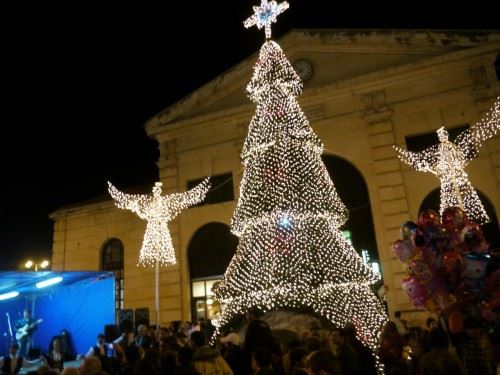
The event "Christmas - New Year 2013-2014", organized by the Municipality of Chania
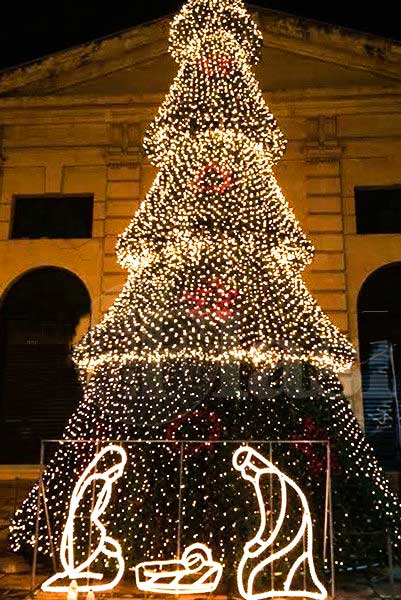
Crib at Christmas Tree in Chania town, 2014
Lamb and pork are roasted in ovens and open spits and there are large family dinners. The Western tradition of sending Christmas cards to all your friends and family slowly gets adopted.
The Christmas Pig
In Crete it was formerly the custom for every household in the village to fatten a pig, the "swine" (chíros) as it was called. The pig was slautered on Christmas Eve and on Christmas was the main dish.
On the second day of Christmas, the villagers cut the meat of the pig and they made:
- • Sausages (loukánika)
- • Apákia: smoked meat
- • Thick jelly (tsiladiá): all traces of meat were removed from the head of the pig and all boiled together. The broth with special preparation turns into a thick jelly with inside pieces of meat.
- • Sýglina, ie meat of pig cut into small pieces, which were smoked and put in large containers and covered with melted fat of the animal. The fat clots, soon after the heat of the meat was gone, thus can be maintained for several months.
- • Omathiés, pig intestines stuffed with rice, raisins and chopped liver.
- • Tsigarídes, fat pieces cooked with spices and eaten with bread, for a snack in the countryside, where they were harvesting the olives.
The Christmas Pig was the main source of meat for several weeks. The rest of the year the Cretans kept a diet extremely low in meat, the famous Cretan diet (Mediterranean diet), that gave the Cretans of decades longlasting health and longevity.
Nothing is wasted from the Christmas pig, for each piece of the animal had its use. Even its bladder, the "foúska" as it is called, was washed and cleaned and then inflated to become a ball, a valuable gift for children of that era.
Christmas bread - Christopsomo
There is no better bread to bake for the holiday season than this delicious Greek Christmas Bread - Christopsomo, a slightly sweet, light, buttery bread, infused with cinnamon, orange and cloves, all the warm flavours of Xmas.
It has a lovely melt in your mouth texture, and is a great bread to make to have for Christmas breakfast or as a snack, whatever your religion. Christopsomos in Greek literally means Christ's bread.
Like all Greek religious holidays, there are special foods that are made just for those occasions. Some of the celebratory foods made at Christmas in Greece are favourites such as Kourabiethes and Melomakarona, although of all foods, bread has the most religious significance in the orthodox church.
In fact there are many different breads made in Greece especially for religious holidays, such as Tsoureki for Easter. Christmas bread is made the day before Christmas, and there is a lot of care and attention put into the baking of it, the best quality, fresh ingredients are bought especially to make it. It is then eaten traditionally, on Christmas Day.
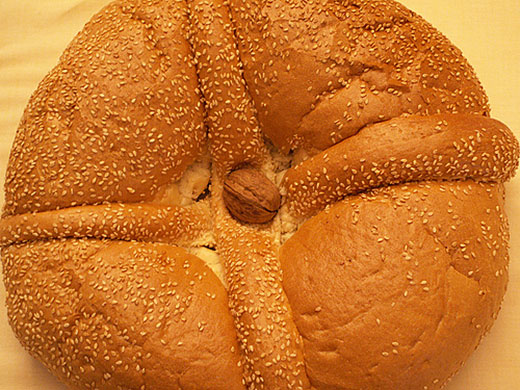
The Christmas bread is usually round in shape, the top is decorated from the dough with a byzantine cross flavoured with aniseed, the ends of the cross swirling around golden walnuts. Other variations with decorating the loaf, can be to use the dough to make a family crest or shapes representing the family's profession.
There are many, many variations to this recipe all over Greece. For example, the Christopsomo Sfakiano - is a particular recipe from Sfaka in Crete. They cover this bread with sesame seeds.
Sfakiano Christopsomo
Ingredients
2 pounds of flour
1 piece yeast
1 1/2 cup of olive oil
3 cups of tea sugar
1 teaspoon cinnamon
1 1/2 teaspoon cloves crushed
1 teaspoon crushed mahlepi *
1 teaspoon anise
1 teaspoon coriander
2 vanilla
2 pieces of gum (crushed with a little sugar)
1 teaspoon baking powder
1 cup of orange juice
1/2 teaspoon salt
4 nuts
1 cup of sesame
How to make it:
In a bowl, dissolve the yeast with two tea cups of lukewarm water, add half the flour and a little oil. Work the mixture to absorb the liquid and become a little thin dough. Cover with warm cotton towel and leave in a warm place. Boil half a cup of water with coriander and anise, strain and let cool down. When the dough has doubled in volume add the sugar, salt, spices, the remaining olive oil, the juice from the cooked coriander and anise, orange juice and finally the remaining flour, which you mix with the baking powder. Knead the mixture with quick and powerful movements (if you put it in the mixer, set it to work on medium speed). If the dough is too thin, add a little flour on top. To work easier, dip your hands every so often in warm water. When you obtain a smooth and homogeneous dough, cover with two cotton towels and leave in a warm place until it doubles in volume. Divide the dough into quarters for 4 pieces of round Christopsoma. Place in the center on top a nut and sprinkle with plenty of sesame. Bake the loaves onto two oiled sheets for 45 to 55 minutes at 180° C, until gold brown.
* Mahlepi (Mahleb in Arabic) is an unusual Greek spice with a distinctive, fruity taste. The finely ground mahlepi powder is made from the inner kernels of fruit pits of a native Persian cherry tree. For many Greeks, the sweet smell of mahlepi always suggests the aroma of freshly-baked tsoureki, a traditional sweet bread with mahlepi baked for Greek Easter. Mahlepi is also used in holiday cakes and cookies.
Boat vs tree: A conflict of Christmas cultures in Greece
‘ Imported tradition’ being abandoned for quintessential Greek symbol
Greeks are increasingly turning to decorating small Christmas boats instead of trees, considered an imported tradition, in the mistaken belief they are reviving an old Greek custom.
“We are slowly abandoning Christmas trees, which are considered a foreign custom, and turning to ships instead,” said Erika Vallianou, a journalist from the western island of Cephalonia.
“It’s part of a general trend to revive old customs. We are trying to recover the island’s distinct color that was lost when all our buildings collapsed in a big earthquake in 1953,” she said.
Cephalonians have even set up a citizens’ group to promote the boats and its results are already evident. “Every Christmas, more and more boats appear in banks, hotels and shops,” Vallianou told AFP. Sparing the island’s unique population of black fir trees is put forward as a further argument in favor of the vessels.
The Christmas boats are made of paper or wood, decorated with small, colorful lamps and a few, simple ornaments. They are usually placed near the outer door or by the fire and the bow should always point to the interior of the house. With golden objects or coins placed in it, the ship symbolizes a full load of riches reaching one’s home. And the Christmas boat is making inroads into mainland Greece.
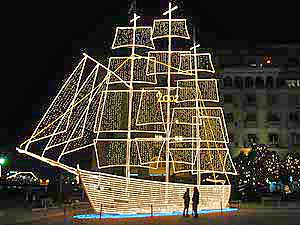
Every December, Greece’s second city, Thessaloniki, erects a huge, illuminated metal structure in the shape of a three-mast ship next to the Christmas tree in its main Aristotelous Square.
“The Town Hall introduced the ship in 1999. Thessaloniki is a port city and we thought this would show appreciation for the role the sea played in the city’s economy,” said Thessaloniki Municipal Councilor Vassilis Gakis.
“Our ship was the first of its kind in Greece. Many other municipalities are adopting it, but their models are not as big as ours,” he told AFP.
Even the vast majority of Greeks who continue to stick to the Christmas tree consider it a foreign import. The modern Christmas tree entered Greece in the luggage of the country’s first king, Otto of Bavaria, who ascended to the throne in 1833 but the tree did not become popular before the 1940s.
The ship, by contrast, is viewed as a quintessential Greek symbol. Greeks have been seafarers for thousands of years and the country is today one of the world’s mightiest shipping nations.
But scholars are skeptical about the ships’ Christmas role. “Ships are not Christmas trees,” said Dimitris Loukatos, one of Greece’s most important ethnographers, as early as 1975. “Though it is true that children on the islands sang Christmas carols holding illuminated model boats in their laps,” Loukatos said.
For children, they served as a lantern in the dark or as a box for presents collected in return for singing carols. “But in other parts of the country, children held other symbolic objects, such as miniature models of the Saint Sophia Church in Constantinople (Istanbul),” said Loukatos.
“Using boats as Christmas ships is a new-fangled development,” Ekaterini Kamilaki, president of the Hellenic Folklore Research Center told AFP.
The Christmas tree, assumed to be foreign, may even have some Greek roots. Use of decorated greenery and branches around New Year is recorded as far back as in Greek antiquity, as it is in other pre-Christian cultures.
Tree branches and green bushes called “Christwood” always had a place in Christian households during the medieval Byzantine and Ottoman empires. “Whether its enemies like it or not, it is certain that the Christmas tree existed in the Byzantine Empire,” Kamilaki said, citing historical evidence from fifth-century-AD northern Syria. “We don’t want to ban the Christmas tree. It has roots in mountainous Greece,” said Gakis, explaining why the tree and the boat coexist in Thessaloniki’s Aristotelous Square.
Real vs fake trees - 21 December, 2007
Are artificial Christmas trees more environmentally friendly than real firs? A Corfu man has asked municipal officials to remove the tree they have erected in front of his cafe, which serves organic food and drink. Others claim real trees bearing the approved seals do in fact benefit the environment, as they are grown on tree farms, creating a source of income for mountain villages.
From: Ekathimerini