

Marine life in Sfakia and Crete
Greece is a maritime country. Because of its geology the sea is never far away and has played and still is playing a very important role in daily life
The Greek islands
"The
Greek islands have always been the channels and receivers of civilization.
But our islands are linked to each other and to the great civilized
centers overseas by ships. Merchant ships. They are the principal
conveyors, fetching and carrying civilization to one place and transmitting
it to other places further away. They above all have contributed to
the spread of Greek civilization and the transmission of the Greek
spirit. The spirit that, fortunately for mankind, was born in a country
which, thanks to its geographical position, was able to scatter it
throughout the world and inspire mankind."
A
Greek Admiral
Also
the animals living in the sea, hunted by fishermen on their
boats, play a crucial role to Greece and to Crete.
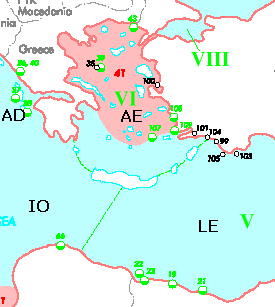
East Mediterranean Sea
The Mediterranean Sea
The Ionian Basin, in the area known as the Ionian Sea (IO), lies to the south of Italy and Greece. The deepest sounding in the Mediterranean (5,092 meters) has been recorded in this basin. A submarine ridge separates the Ionian Basin from the Levantine Basin. South of the Strait of Sicily the shelf widens to as much as 200 kilometers off the Gulf of Gabes (Tunisia) and a little less in the Sirte Gulf (Libya). The shallow water of these two areas shelter the widest seagrass beds in the world (comprised mainly by Posidonia oceanica, and Cymodocea nodosa). These are threatened by oil exploitation and by deposits of gypsum resulting from phosphate production in Tunisia. The Levantine Basin (LE) covers the area bordered by Crete, south of Turkey, Syria, Lebanon, Israel, Egypt and part of Libya, including Cyprus. In front of the Nile Delta (off Port Said at the entrance of the Suez Canal), the shelf widens to 130 kilometers. Species migrate into the Mediterranean from the Red Sea through the Suez Canal. The island of Crete separates the Levantine Basin from the Aegean Sea (AE), which comprises that part of the Mediterranean Sea bounded on the west and north by the coast of Greece and on the east by the coast of Turkey.
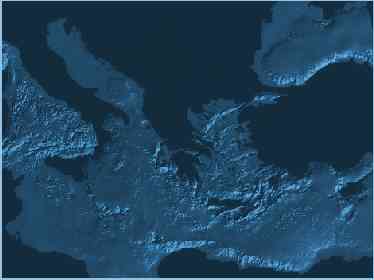
Mediterranean Sea floor
The Aegean Sea is about 700 kilometers long and 340 wide (total area 214,000 square kilometers) and contains numerous islands. The Aegean has an the average depth of about 360 meters and a maximum depth of 3,543 meters occurring to the east of Crete. The Adriatic Sea (AD) is a long canal (about 780 kilometers) bounded by Italy on the west and by Slovenia, Croatia, Bosnia, Montenegro and Albania on the east. The Adriatic has an average width of 240 kilometers and a total area is 131,000 square kilometers. The Po River enters in the north of this sea, where the shelf extends for about 550 kilometers. The Adriatic is mainly shallow with an average depth of 444 meters and a maximum depth of 1,324 meters occurring to the south of the central area.
Fish found in South Crete
Fish pictures courtesy of Fish Tavern 3 Brothers, Chora Sfakion
|
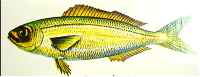
Bogue Lat: Boops boops Greek: Gopa Max 35 cm |
 |
| White
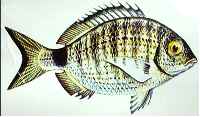
Bream Lat: Diplodus sargus Greek: Sargos Max 45 cm |
 |
| Two-banded
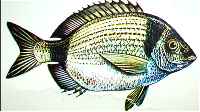
Bream Lat: Diplodus vulgaris Greek: Spáros Max 25 cm |
 |
| Common
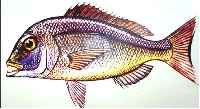
Sea Bream Lat: Pagrus pagrus Greek: Fagri Max 75 cm |
 |
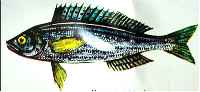
| Picarel Lat: Maena smaris Greek: Marida Max 20 cm |
 |
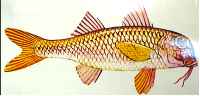
| Striped
Mullet Lat: Mullus barbatus Greek: Koutsamoura Max 25 cm |
 |
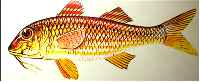
| Red
Mullet Lat: Mullus surmuletus Greek: Barbouni Max 40 cm |
 |
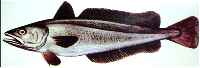
| Hake Lat: Merluccius merluccius Greek: Bacaliaros Max 80 cm |
 |
| Gilthead
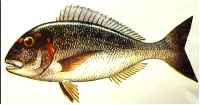
sea bream Lat: Sparus auratus Greek: Tsipoura Max 60 cm |
 |
| Red
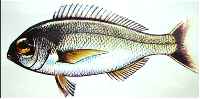
Bream Lat: Pagellus centrodontus Greek: Lethrini Max 50 cm |
 |
| Swordfish
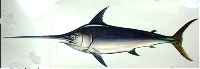
Lat: Xiphias gladius Greek: Xiphios Max 400 cm |
 |
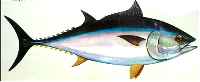
| Bluefin
Tuna Lat: Thunnus thynnus Greek: Tonnos Max 200 cm |
 |
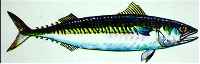
| Atlantic
Mackerel Lat: Scomber scombrus Greek: Scoubri Max 50 cm |
 |
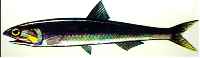
| Anchovy Lat: Engraulis encrassicholus Greek: G'avros Max 20 cm |
 |
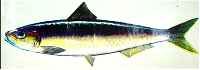
| Sardines/
Pilchard Lat: Sardina pilchardus sardina Greek: Sardella Max 20 cm |
 |
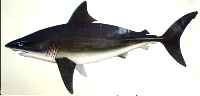
| Porbeagle
Shark Lat: Lamna nasus Greek: Carcharias Max 400 cm |
 |
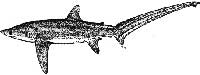
| Bigeye
Thresher Shark Lat: Alopias superciliosus Greek: Max 461 cm |
 |
All kinds of subspecies, like sharpsnout sea bream (Puntazzo puntazzo L.), red sea bream (Pagrus pagrus L.), white (Diplodus sargus sargus), and annular sea bream (Diplodus annularis), sea bass (Dicentrarchas labrax), Mullus surmuletus, Pagelius erythrinus, Pagrus pagrus (Red Porgy, common sea bream)
Invertebrates, mollusks and crustaceans found in South Crete
| Octopus | 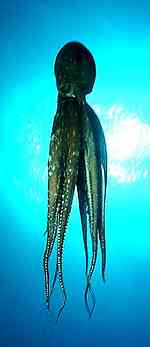 |
| Red Lobster (family Homaridae) | 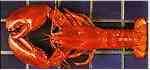 |
|
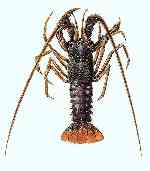
Spiny Lobster (Palinuris Elephas) Rock Lobster (Crayfish, Langouste) |
 |
| Squid (Loligo) | 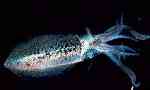 |
| Shrimps (Natantia) | 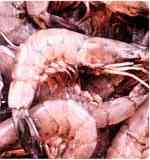 |
| Sponge (Porifera) | 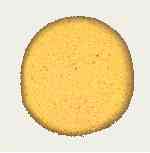 |
Ecology, pollution and protection
With 16,000 kilometers of coastline, Greece has the most important seashore of the Mediterranean, but in large part due to the complexity of its legislation and institutions dealing with environmental matters at the national level, there is no real network of coastal protected areas. The eight existing areas along the coast cover 29,000 hectares but include mainly terrestrial features. This country has begun to give responsibility for the management of protected areas to NGOs. The following Marine Protected Area has been recorded: Alonissos (Northern Sporades). The Levantine Basin (LE) contains 9 marine protected areas (1 Cyprus, 3 Israel, 5 Turkey) although none are present along the southern and eastern coast.
"There is less sea-life that can be seen by tourists directly, as the sea fauna is threatened. This is because of dynamite-fishing that is still done by fishermen from the Sfakia, and at a smaller scale by the inhabitants of Gavdos. The second reason is the pollution from petroleum. Oil-Tankers now and then stop in between Gavdos and Gavdopoula to clean their tanks. Third reason is that there is only a small continental slope, the area where seagrass beds feed the animals, and they are damaged by overfishing.
Snorklers can see some small Fish, Crabs, Starfish, an Octopus, Squid and Cuttlefish: The Cephalopods, Sponges, now and then or a Murena in the rocks. Sea-urchins are frequent, and at certain times there is plenty of Jellyfish, but the transparent species that does not bite. There are some quite impressive fish, such as the Saragos, and there are Tuna and Sea Turtles passing by, but you need a boat and scuba-equipment tho observe these.
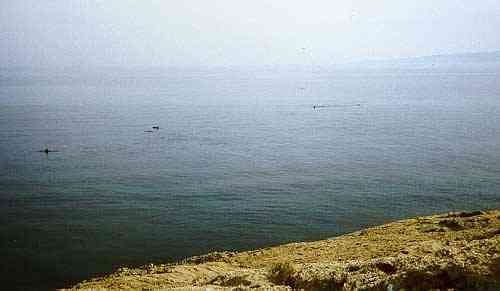
Dolphins playing in the peaceful waters immediately off the southeastern rocky coast of Gavdopoula. In the background we can see the eastern parts of Gavdos.
Sea Mammals found in South Crete
|
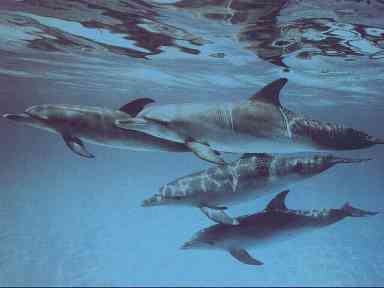
Mediterranean striped dolphins (Stenella coeruleoalba) |
 |
|
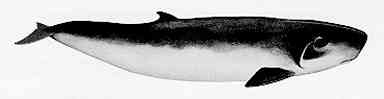
Pygmy sperm whale (Kogia breviceps) |
 |
| Fin Whale (Balaenoptera physalus) | 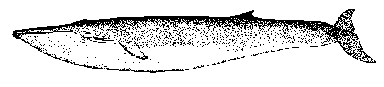 |
During the warm months of the year the species of the Fin Whale (Balaenoptera physalus) is commonly found in the East Ionian Sea and sightings have been recorded all along the Greek continental slope, in South Peloponnissos , South Crete and Karpathos Island sea areas (e.g. at the limits of the Aegean arc where depth increases very steeply). It can grow to a length of 26m (85ft) and weigh 30-80 tonnes but on the average it is much smaller.
Several species of marine mammals have reached dangerously low population levels, and their survival has become questionable unless immediate measures are taken for their conservation. The species in which this is most evident is Monachus monachus (Mediterranean monk seal), which depends on rocky islands and archipelagoes free from disturbance as breeding sites. The population of these seals in the Mediterranean is probably less than 300 individuals. Their greatest concentration occurs along the Turkish and Greek coasts and around the Aegean islands. Very small populations also still exist in Morocco, Algeria and Libya. Morocco is making efforts to consolidate the monk seal population that occurs on its Atlantic coast near Mauritania. About 20 different cetacean species has been reported in the Mediterranean Sea, about half of which form part of Atlantic populations entering the sea only sporadically. Only nine small cetacean species and three large whales species are sighted frequently in the Mediterranean Sea.
Surface currents, which cross through the Straits of Gibraltar and circulate in the western part of the Mediterranean Basin, are also an important factor in explaining the presence of cetaceans/ whale family. These currents are used by different shoals of fish, including tuna (Tunidae) and swordfish (Xiphias gladius), to aid them on their migration to breeding or spawning areas. The migrations are followed by predators, including killer whales and sperm whales, that enter the Mediterranean mostly in pursuit of migrating prey. Marine organisms have also been known to enter the Mediterranean Sea through the Suez Canal.
Reptiles found in South Crete
Sea turtles have been swimming and nesting in the Mediterrannean for thousands of years. They are now facing extinction as a result of the destruction of their nesting habitat, pollution and modern fishing methods. If these turtles are to be saved, it is crucial that immediate action is taken. Greece is home to the mojority of the remaining loggerhead turtles in the Mediterranean, with the main nesting beaches on Zakynthos, Crete and Peloponnese. Of these, Zakynthos is the single most important nesting area in the Mediterranean for the loggerheads. An average of 1300 nests are made each year and these are concentrated on six beaches totalling only 5km in length.
Every year about 3000 nests are monitored by the STPS along 75km of sandy beaches on Zakynthos, Peloponnese and Crete.
The loggerhead (Caretta caretta), leatherback (Dermochelys coriacea) and green (Chelonia mydas) are endangered species of marine turtle found in the region. While the loggerhead remains relatively abundant, it seems to have deserted many parts of the Western Basin where it is disturbed by fishing activity. The other two species are becoming increasingly rare.
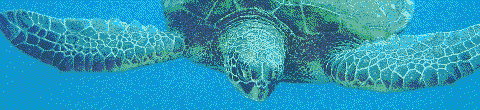
Loggerheads reach about 82 to 105 cm (32-41 in.) and 66 to 101 kg (146-223 lb.).
History & Mythology
As far back as Ancient Greece, dolphins have been known and loved by mankind, for legends relate their kindnesses to humans and their rescuing heroics. During the Greek god Apollo's travels from Crete to Delphi, he frightened some pirates by appearing in their ship as a dolphin, warning them to reform and worship him as Apollo Delphinius. Another Greek god, Dionysos, when learning that some pirates planned to sell him into slavery, threw them overboard and turned them into dolphins.
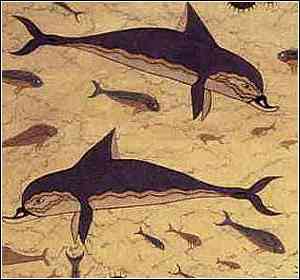
Dolphins: Frescoe from the Queen's Megaron in the east wing of the Palace of Knossos.
In the Palace of King Minos, Knossos c. 1500 B.C., the queen's apartment or 'megaron' consisted of a fairly spacious suite of rooms. There you find the famous dolphin frieze, in the main room. Decorative rosette panels surround the door openings and run across the walls. The importance of both the sea and of animals as decorative images is clearly illustrated here.
The sense of kinship between humans and dolphins goes back thousands of years. Citizens of ancient Crete honoured dolphins as gods, while the Greeks kept a special sanctuary for what they considered to be the dolphin god.
From the Arctic to the Antipodes, people have celebrated and sung of whales and dolphins for centuries, but the first person to write about them was the Greek philosopher, Aristotle, who lived from 384 to 322 B.C. He described whales, dolphins, and porpoises as cetaceans and distinguished them from fish: "The dolphin, the whale and all the rest of the cetacea, all that is to say, that are provided with a blow-hole instead of gills, are viviparous...The dolphin has been asleep with his nose above water and when asleep he snores...". Aristotle also described how fishermen who caught dolphins would "nick their tails and set them adrift again and by this expedient their ages are ascertained". Thus, it could be said that the Greeks carried out the first non-lethal or benign research on marine mammals. Greek poets and artists celebrated the sea (Thalassa) as the source of life, as it is in many creation myths. Apollo, Greek god of the sun (who turned into a giant dolphin), and Poseidon, god of the sea, protected marine mammals. Unfortunately nowadays Greek fishermen hate dolphins, because they ruin their nets...
Although most of the mythology associated with Delphi is connected with Apollo, he was not its first inhabitant; this distinction belonged to either Gaia/Ge (the Earth goddess) or Themis (another primordial goddess). In the Homeric Hymn to Apollo, Apollo killed a monstrous snake, the Python (that gave the god his title Pythian) and left it to rot (an etmylogical play on the Greek verb pytho, "I rot"); the early name of Delphi was supposed to be Pytho. Some have seen this as representing the displacement of the site's earlier divine inhabitant. So too the name Delphi received an etymological explanation: Apollo appeared in the form of a dolphin (delphis is the Greek word for "dolphin") to sailors on a Cretan ship. Leaping on board, he brought the terrified sailors to Crisa, the coastal port near Delphi, where he transformed himself into a handsome youth and appointed the sailors as priests of his temple. Some have seen in this myth of Cretan immigration a connection with Apollo's origins in the Near East, since Crete was the main point of connection between the Levant and the Greek-speaking world. It too might explain the prominent role played by the Delphic oracle in marine expeditions, particularly when founding new colonies. Delphis is also the Greek word for "womb" (that distinguishes the dolphin as a mammal from other sea-creatures), and this is probably also connected with the ancient conception of Delphi as being the center of the world.
Fish in Greek and Cretan cuisine
With seafood being a huge part of the Mediterranean diet, we take a look at the fish that feature strongly in Greek and Cretan cuisine.
Surrounded by the glorious Aegean, Cretan and Libyan Sea is the Hellenic Republic, and with so many people and their livelihoods dependant on the catches from the ocean, it's no wonder that seafood features so highly in the Greek diet.
Octopus drying on a makeshift beachside brick ledge, overlooking the Aegean, is a scene synonymous with Greece; while eating the octopus grilled or even marinated with the glistening azure blue ocean as a backdrop - well, then you truly know you are in God's playground.
The boats entering the harbour with dinner for many nearby tavernas and homes, the beauty being, you don't know what fish you are going to eat that night - it's whatever the fishermen caught. From sardines to snapper, Greeks have made their mark with seafood in their cuisine, utilising a number of methods to prepare, cook and eat fish.
The health benefits of eating fish are numerous. Fish are nutritious, provide energy (kilojoules), protein, selenium, zinc, iodine and vitamins A and D (the latter only in fatty fish).
A hero of Greek cooking are sardines (sardeles). Eaten as a meze or meal, these little gems are featured in every region of Greece's cookery, especially ones close to the oceans and islands. The most common method of cooking is grilled with just a little lemon and oil as a dressing or fried, in flour and served with lemon and oil again. The smaller the sardines the better, especially for meze. These little delights go hand-in-hand with a shot of ouzo or raki in the sun and are perfect finger food in summer. Sardines can also be served braised in a tomato based sauce.
Barbounia (red-mullet) is the best tasting fish you will ever eat, whether fried or grilled, and is one of the commonly available fishes in the Aegean. The paler cousin of the red mullet can be slightly cheaper. Similarly, trout, or river trout, becomes dependant on Greek regions that are mountainous and distant from the oceanside. Trout farms are common in Greece for mass production of this fish.
Snapper as a whole becomes a feast for a family. Baked whole in the oven with fresh herbs, on a bed of tomatoes, garlic and potatoes and with sliced lemons scattered over the fish and vegetables makes for the perfect meal.
Whiting (gavros) is also a very popular fish in Greece. Again, served grilled or fried as a meze, but it can be baked as well with tomatoes or peppers making a well-rounded meal for the family.
Bakaliaro (cod) is probably the most widely eaten fish, especially in the winter. If you go to the markets or specialty delis, you will find salted dried cod. But it's becoming more commonly available at local supermarkets too. Bakaliaro is traditionally served with skordalia, a potato garlic dip. You need to pay special attention to the way you prepare the salted cod. After purchasing, you need to rest the bakaliaro in water, and change it about seven times every couple of hours to get rid of the excess salt. Then, when the water is less salty, batter the pieces of cod and deep fry them.
With all this fish, and leftovers - not just the bones but the flesh also - Greeks have devised a way to not let anything go to waste, in the form of psarosoupo. Fish soup is one of the healthiest of Greek dishes. Made with fish stock by boiling water with bones, along with a braise of onion, garlic and carrot and celery, the soup itself forms a delicious and delectable broth in which you can add whatever vegetables you like, but traditionally it's potatoes, carrots and onions. The soup is then finished with an avgolemono (egg and lemon sauce). When you order this dish in Greece, you are asked whether or not you want the fish with the soup. And the fish is presented alongside the soup, on a separate plate.
There is a whole ritual for fish eating in Greece. It is common to be served the whole fish. A whole fish is eaten as a special treat and Friday evenings, that are meat free for religious purposes, are normally the nights to consume grilled fish. Because the hero of this dish is the fresh produce, fish is served with humble accompaniments. The most common of all are horta (wild greens). Plain, steamed with a hint of olive oil and lemon dressing, the two become a match made in culinary heaven.