

Diloti Card Game - Sfakia Winter Sports
Fishing for cards


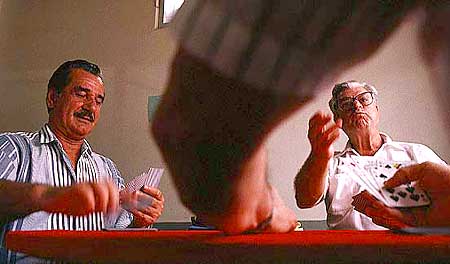
Specially during the winters in Sfakia people play cards in the local tavernas. The favourite game is Diloti, an intriguing game of collecting, or fishing, cards to gain points...and money. Sometimes really a lot of money: thousands of Euros!
After the tourists have left in November, the Sfakians slowly slowly get into practice and these lines of games culminate on Christmas Eve and New Year, when the huge amounts of money will change hands. The game is played by men of all ages, and games can go on for hours. It's a fascinating sight to see four black shirted men with huge moustaches gathered around a table, with sparse light, heavily smoking, and the nervous tension building up, to the final count of points, and wallets being pulled. It's also played in a more relaxed style, with a lot of noise and showing of courage, bravoure and machismo, just for fun and honour.
The game is very similar to that of Casino, more widely known in the West. Diloti is a kind of 'fishing game', trying to take cards from the table to gather points. Funny that the Sfakian fisher men fish for cards, when the sea is not the place to be in winter.
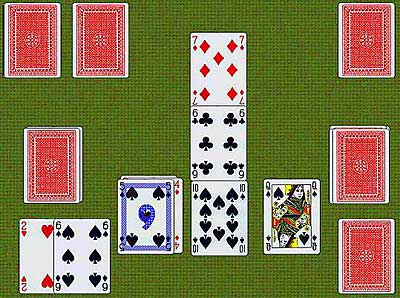
Casino is the only 'fishing game' to have become popular in English speaking countries. Casino first appears in the card game literature at the end of the 18th century in London, and shortly afterwards in Germany. In the late 19th century it became fasionable in America. A regular 52 card deck is used. The aim is to capture cards from a layout on the table, by playing a card from hand which matches in number a table card or the sum of several table cards. Picked up cards are accumulated in a pile to be counted at the end of the round. A numeral card may be played and combined with other cards on the table, placing them together to form a build. A build can be made out of any collection of numeral cards which can be captured by a single numeral card. A sweep occurs when a player takes all the cards from the table, leaving it empty and forcing the next player to trail.
The game works best with from 2 to 4 players, though in theory more could take part. It has the distinction of being one of the few games which will deal out evenly to two, three, or four players. Four players can play in partnerships, two against two, with partners sitting opposite each other.
In fishing games each player has a hand of cards and there is a layout of face up cards on the table. Each player in turn plays a card. If it matches a card or cards in the layout, the played card and the matched cards are captured and placed face down in front of the player. If the card played does not match it is added to the layout. In the Western style of fishing games, cards are only played from the hand, not turned up from the stock. It is general possible to use a card to capture several cards at once if the ranks of the captured cards add up to that of the played card. Various forms of these games are surprisingly widespread throughout the world.
Diloti: How to play
Objective
To obtain more points than your opponent.
What counts as points?
By the end of a round, having more cards than your opponent counts as 4 points towards your score.
Having the 2 of
clubs and each ace count
as one point each. Having the 10 of diamonds
counts as two points towards your score.
Having a xeri (sweep) counts as 10 points towards your score. A xeri is described later.
Game Play
The dealer deals each player 6 cards to start and places 4 cards on the board. The non-dealer player goes first.
Players alternate turns. Each turn involves choosing a card from your hand and doing either a drop, take, or a join with it and with cards on the board. When each player has used all of their cards in their hand, the dealer deals a new set of 6 cards to each player and game play resumes. This occurs until all of the cards in the deck are gone. This indicates the end of the round and the score is tallied.
What's a drop? A take? A join?
Drops, takes and joins are the things you can do with a card in your hand to the cards on the board.
* Drop:
A drop simply means to place a card in your hand on the board. A player would generally do this when he cannot (or does not want to) take or join cards on the board.
There are restrictions to when you can and cannot drop cards, in particular, when you have a joined set of cards on the board. This will be described below.
* Take:
A take involves
taking cards from the board with the card in your hand ('fishing').
You can take cards on the board that add up to the value of the card
in your hand. For instance, you may take the 7 of clubs
on the board with the 7 of diamonds
in your hand. Or, you can take the two of clubs
(a point card!) and the 3 of hearts
with the five of spaes
in your hand.
You may even take
multiples of the same value with one card from your hand. For example,
you may take the ace of clubs
(a point card!), the 4 of hearts ,
the five of diamonds ,
and the five of spades
with the five of hearts
in your hand. Or, you may only take the ace of clubs
(a point card!), the 4 of hearts ,
and the five of diamonds
with the ten of diamonds
(a card worth two points!) from your hand, leaving the five of spades
on the board.
Face cards (jacks, queens, and kings) are special in that they do not have a numerical value. Therefore, you can only take one face card with the same type of face card from your hand.
* Join:
A join involves
combining one, some, or all cards on the board with a card in your hand
such that it can only be taken by a card that you must have in your
hand in your next turn. For instance, there's a two of clubs
(a point card!) and a four of spades
on the board, and you have an ace of spades
(a point card!) and a seven of diamonds
in your hand. You can use the ace of spades
in your hand to join it with the two of clubs
and the four of spades
on the board to form a 7-join. As a result, if your opponent has an
ace, he can't take the ace on the board because it's included in the
7-join. Similarly, if he has a 3, he cannot take the ace and the two
on the board because they are joined with the 4 as a 7-join. However,
if he has a seven, then he can take it. Joins can be taken by a card
of equal value by either opponent.
A join is shown in the game by stacking the joined cards as a column with a number on the top with a circle around it. A red background within the circle indicates that this is your join. A yellow circle indicates that it is your opponent's join.
You cannot drop cards while you have a join on the board. This is the restriction mentioned earlier. However, you can still take other cards on the board, or build on joins in special ways (described below).
Opponents can build
on your join to make higher-valued joins to claim ownership of the new
join. In the previous example, you have a 7-join on the board. If your
opponent has a two of diamonds
and a nine of hearts , he
can join his 2 with the 7-join to make it a 9-join, and he claims ownership
of the joined cards. That is, your obligation to the 7-join is gone.
Now, you can drop a card, take other cards on the board, take the 9-join
if you have a nine in your hand, or build a 10-join if you have an ace
and a 10 in your hand.
You cannot build a higher-value join on your joined set. You can only do this on your opponent's joined set. However, you can build multiples of your or your opponent's joined set called a soy, which is described below.
Face cards cannot be joined in any way. Nor can they be used to take joined sets.
* Soy:
There's a special kind of join called a soy where there are enough cards in a joined set to represent a multiple of the declared join value. Soys are shown in this game by underlining the number within the circle on top of the joined card column.
Soys are special
in that players cannot change the value of the soy. That is, soys are
locked in to that join value, and cannot be changed while the soy is
on the board. If cards are added to the soy by either opponent, it must
preserve the value of the soy. For example, if there's a 6-soy and a
four of spades on the board,
and you have a two of diamonds
and a 6 of clubs in your
hand, you can join the 6-soy with the four and the two to build a larger
6-soy.
A soy is a particular kind of join. Therefore, the player who "owns" a soy on the board is under the same obligations for a join outlined above.
A user can only have at most one join or soy on the board. However, you can keep building upon a soy as long as you have the card to take the soy in your hand.
Special Note:
When adding cards to your join to make it a soy, it must preserve the
original join value. That is, you cannot build upon a 4-join with an
ace on the board and a 5 in your hand to make a 5-soy. However, you
can build upon a 4-join with an ace on the board and a 3 in your hand
to make a 4-soy.
What's a Xeri (sweep)?
When a player takes
all of the cards from the board, it is called a xeri (pronounced kse-ri')
and that is worth 10 points. Therefore, the general strategy to diloti
is to take as many point cards as possible without allowing your opponent
to get a xeri. The absolute last move of the game cannot cause a xeri.
For example, you hold a single card, the 10 of clubs ,
and there is a 10 of hearts
on the board, your opponent doesn't hold any cards, and there are no
more cards to deal. When you take the 10, that doesn't result in a xeri.
More Greek card games:
- • Pilota - similar to the French game Belote, played with 32 cards. Bourloto may be the same or a similar game.
- • Koltsina (or Koultsina), also known as Pastra - a fishing game, which may possibly be similar to the Arabian game Basra.
- • Kseri is another fishing game, said to be similar to the Turkish game Pishti.
- • Biriba - a two pack rummy game in which the aim is to make "biribas", which are sets of at least seven cards of the same rank or seven cards in sequence in suit.
- • Koum-kan - sometimes written Kum-kan or Kun Kan - is a two deck rummy game in which each player is dealt 11 cards.
- • Thanassis is another Rummy variation.
- • Prefa - a variation of Russian Preference, highly valued among university students and old village people!
- • 66 - the Greek version of the German game of 66.
- • Agonia (Agony) is the Greek version of Crazy Eights, as usual with lots of variations.
- • Koupes, the Greek version of Hearts is becoming more and more popular lately, mostly among younger people.