

The Olive Tree and Olive Oil
Today more than 90% of the olive oil produced in Crete is of the higher classification of 'extra virgin'
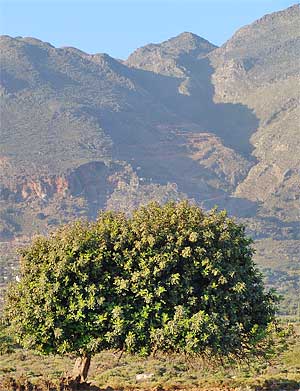
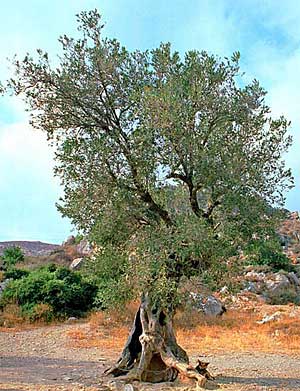
Frangokastello, Sfakia: olive tree
Greece is full of olive groves. The Olive Tree, "the tree that feeds the children" according to Sophocles, is the protagonist of the Greek nature and history as olive oil is the protagonist of the Greek diet.
The indigenous olive tree (wild olive tree) first appeared in the eastern Mediterranean but it was in Greece that it was first cultivated. Since then, the presence of the olive tree in the Greek region has been uninterrupted and closely connected with the traditions and the culture of the Greek people.
Olive oil, as it is testified by the fossilised olive trees which are 50,000-60,000 thousand years old and were found in the volcanic rocks of Santorini, has always been a distinctive element of the country. Its systematic cultivation started in the pre-historic times: the Stone and Bronze Age.
Olive oil production held a prominent position in the Cretan Minoan and the Mycenaean society and economy as is shown by excavations and findings (earthenware jars, recordings on tablets, remains of oil mills). During the Minoan Period, olives were treated and oil was produced which in turn was stored in earthenware jars and amphorae. Quite often it was exported to the Aegean islands and mainland Greece. Apart from the financial gains, though, the olive tree was worshipped as sacred and its oil, besides being offered to the Gods and the dead, was also used in the production of perfumes, medicine and in daily life as a basic product in diet, lighting and heating.
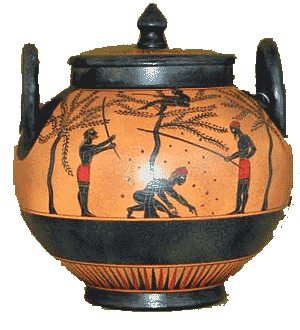
Olive harvesting on ancient pot
An undoubted native of Syria and the maritime parts of Asia Minor, its abundance in Greece and the islands of the Archipelago, and the frequent allusions to it by the earliest poets, seem to indicate that the olive tree was there also indigenous; but in localities remote from the Levant it may have escaped from cultivation, reverting more or less to its primitive type. It shows a marked preference for calcareous soils and a partiality for the sea breeze, flourishing with especial luxuriance on the limestone slopes and crags that often form the shores of the Greek peninsula and adjacent islands, like Crete.
The olive tree, even when free increase is unchecked by pruning, is of very slow growth; but, where allowed for ages its natural development, the trunk sometimes attains a considerable diameter. The olives in the East often receive little attention, the branches being allowed to grow freely and without curtailment by the pruning-knife; water, however, must be supplied in long droughts to ensure a crop; with this neglectful culture the trees bear abundantly only at intervals of three or four years; thus, although wild growth is favorable to the picturesque aspect of the plantation, it is not to be recommended on economic grounds. Where the olive is carefully cultivated, as in Crete, it is planted in rows at regular intervals, the distance between the trees varying in different olivettes, according to the variety grown. Careful pruning is practiced, the object being to preserve the flower-bearing shoots of the preceding year, while keeping the head of the tree low, so as to allow the easy gathering of the fruit; a dome or rounded form is generally the aim of the pruner. The spaces between the trees are occasionally manured with rotten dung or other nitrogenous matter.
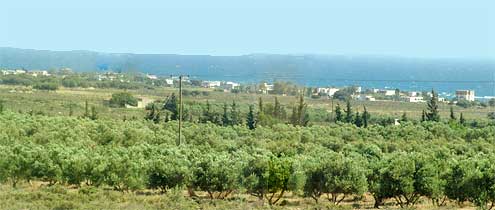
Frangokastello olive grove
The fruit when ripe is, by the careful grower, picked by hand and deposited in cloths or baskets for conveyance to the mill; but in many parts of Spain and Greece, and generally in Asia, the olives are beaten down by poles or by shaking the boughs, or even allowed to drop naturally. In Crete the olives are collected in nets, lying on the ground. In southern Europe the olive harvest is in the winter months, continuing for several weeks.
How olive oil is made
Steps to olive oil making once you've grown and picked the olives:
- 1. Cleaning the olives: Stems, twigs and leaves are removed and the olives may or may not be cleaned with water to remove pesticides, dirt, etc.
- 2. Grinding the olives to paste: Stone rollers or wheels roll in circles on a slab of granite to grind the olives into a paste, or an electric motor attached to a toothed grinder pulverizes the olives as they are flung away from the center.
- 3. Mixing to increase olive oil yield: Mixing or Malaxation for 20 to 40 minutes allows small oil droplets to combine into bigger ones which can be removed in the next step. It is an absolutely necessary step. The paste is often heated to 28 degrees centigrade during this process.
- 4. Separating the oil and water from the fruit (pomace): using a press.
- 5. Separating the oil from the water: the liquid is spun by a centrifuge.
- 6. Processing the oil, further extraction: refining, bleeching and deodorising, to reduce acidity and improve flavor.
- 7. Storage and Bottling considerations: Olive Oil can be stored in containers as mundane as plastic or as indestructible as stainless steel. Oil deteriorates through the action of lipase and other enzymes in the oil and the action of oxygen. Oxidation or rancidity speeds up with light and heat exposure.
- 8. Tasting and rating the oil: Olive oil is graded by its acidity and also by its flavor as judged by experts.
Broadly speaking,
international legislation divides the various classes of olive
oil into
(a) virgin olive oils (i.e. those which
have not been refined) and
(b) the chemically refined oils (called "olive
oil" or "pure olive oil").
Virgin olive oil fit for consumption as is (i.e. "natural") includes:
- 1. Extra virgin olive oil: virgin olive oil which has a free acidity, expressed as oleic acid, of not more than 1 gram per 100 grams
- 2. Virgin olive oil: (the qualifier "fine" may be used at the production and wholesale stage): virgin olive oil which has a free acidity, expressed as oleic acid, of not more than 2 grams per 100 grams
- 3. Ordinary virgin olive oil: virgin olive oil which has a free acidity, expressed as oleic acid, of not more than 3,3 grams per 100 grams
In Crete nowadays modern equipment is being used to produce olive oil.
Olive products of the Chania region, west Crete
The Peripheral unit of Chania produced excellent quality olive oil, mainly from the fine Koroneïki olives. Most, in fact, of the olive oil produced in the county is designated as PDO (Protected Designation of Origin) and PGI (Geographical Indications).
Today in the P.U. of Chania there are 410,000 acres with cultivated olives. The average oil production during the years 2011-2013 ranged to 16,660 tonnes. At the same time the production of edible olives ranged to 150 tonnes.
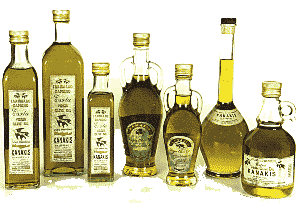
The oil produced in the P.U. of Chania has low acidity and has a rich flavor, which makes it very popular. It is offered in different kinds of packaging, depending on the requirements of the consumers in each country.
There are 17 companies active in the field of olive products in Chania.
Cretan cuisine
In the Cretan kitchen olive oil plays a dominating role. There
is practically no dish, which is not served with olive oil. Even today in daily life
Cretans prefer a vegetarian diet with beans and other pulses,
greens, vegetables and grains, cheese,
pasta and potatoes. Meat dishes are reserved for special events, when they host
guests or go out for dinner together with friends and family.
Salads are drowned in olive oil, so are fresh feta cheese and
vegetables. Dipping bread into the juicy mixture of oil and
tomato juice at the bottom of the salad bowl is a delicacy
no one should miss when visiting Crete.
Health
There is increasing scientific evidence that there are positive health effects from diets which are high in fruits, vegetables, legumes, and whole grains, and which include fish, nuts and low-fat dairy products. Such diets need not be restricted in total fat as long as there is not an excess of calories, and emphasize predominantly vegetable oils that are low in saturated fats and partially-hydrogenated oils. The traditional Mediterranean Diet, whose principal source of fat is olive oil, encompasses these dietary characteristics.
The Mediterranean diet
The term traditional "Mediterranean diet" has a specific meaning. It reflects food patterns typical of some Mediterranean regions in the early 1960’s, such as Crete, parts of the rest of Greece, and southern Italy.
Characteristics:
- • an abundance of plant food (fruit, vegetables, breads, other forms of cereals, potatoes, beans, nuts, and seeds);
- • minimally processed, seasonally fresh, and locally grown foods;
- • fresh fruit as the typical daily dessert, with sweets containing concentrated sugars or honey consumed a few time per week;
- • olive oil as the principal source of fat;
- • dairy products (principally cheese and yogurt) consumed daily in low to moderate amounts;
- • fish and poultry consumed in low to moderate amounts;
- • zero to four eggs consumed weekly;
- • red meat consumed in low amounts; and
- • wine consumed in low to moderate amounts, normally with meals.
As much as can be determined, this diet was low in saturated fat (less than or equal to 7-8% of energy), with total fat ranging from less than 25% to more than 35% of energy from one area to another. Data also indicate that work in the field or kitchen resulted in a lifestyle that included regular physical activity and was associated with far less obesity than was observed in the United States.
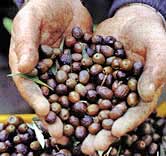
Data about the Olive Tree and Greece
- • Many people claim that the oldest olive tree, 5,000 years old, is in Pano Vouves, in Kolymvari, Chania. The average life expectancy of an olive tree is 300-600 years.
- • The cultivation and exploitation technique today is not very different from the one used in ancient times
- • The Mediterranean area produces 99% of the world olive oil production
- • Greece, despite the fact that it is a small country in magnitude, stands in the 3rd position in the world in the olive oil production, after Spain and Italy
- • There are today approximately 120,000,000 olive trees in Greece (the population of the country is approximately 10,000,000) covering an area of approximately 6 million stremmata (1 stremma=1000 m2 / about ¼ of an acre). Approximately 450,000 Greek families are involved in the cultivation of the olive tree and the processing of its fruit all over the country
- • The prefectures of Heraklion and Messinia are in the first position in the production of olive oil in Greece
- • Greece is the biggest exporter of Extra Pure Olive Oil considered the best quality of olive oil
- • The Greeks are today the first consumers of olive oil compared to any other people and the per capita consumption is approximately 16 kilos annually. In Crete, consumption comes up to 30 kilos per year per person. Scientific research has proven that the Cretan diet is the healthiest in the world
- • Biological cultivation of the olive tree in Greece started approximately 10 years ago in Mani and it is estimated that today it uses 15,000 stremmata while it is expected to exceed 35,000 stremmata in the next years.
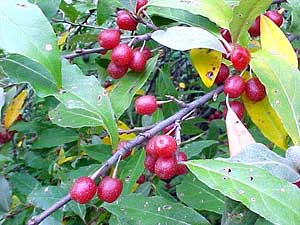
More information about olive oil from Sfakia and Crete is available at our Cretan food and drinks forum:
Cretan food and drinks forum