

Cretans outside Crete
A journey back in time
Nowadays Crete is being overwhelmed with foreigners. From places all over the world people come to visit Crete.
Over history there was a movement the other way around: Cretans went to many other places and many stayed there. In some remote areas we still can find Cretan communities and some of them preserve the old Cretan culture and language. Other places are home to emigrants from Crete, due to its bad economical situation in the seventies of the last century.
Let us explore Crete outside Crete.
• The story of Crete begins around 6000 BC when the first settlers arrived on the island, probably from Anatolia (now a province of Turkey), North Africa, Syria and Palestine. Finds of jewellery and vases from this time show a strong Anatolian and North African influence.
• During the bronze age the whole of the Aegean and countries surrounding Crete were affluent and contented with each area benefitting from the flow of trade. The commercial activities of the Cretans included transporting goods to others. Thus they traveled to Phoenecia for Lebanon's trees to transport to Egypt. Apparently, agreements had been reached between the king of Knossos and the Mediterranean powers that permitted the Cretans to function as intermediaries. Initially, commercial ties were confined to the Aegean. Crete exported pottery and seals, and imported famous Cycladic statuettes from Syros, or obsidian from Melos which held a monopoly on it. From Melos they reached the Argolid, and next central Greece. Knossian influence extended to eastern Greece up to Macedonia. From Cyprus they loaded with timber and copper ore. It served as intermediary for Syrian and Palestenian commerce. A Cretan camel seal suggests ties with Asia or African caravans, which reached the Syrian harbors. Mesopotamian tablets of Mari refer to ties it maintained with Kaftor (=Crete), while in a Middle Minoan tomb in Mesara was discovered a Babylonian cylinder of the age of Hamurabi. There is ample proof, from both Crete and Egypt, that commercial transactions existed from a very early period. In the west, Cretans reached Sicily, Sardinia which shows a religious, industrial and technological influence, the Balearic Islands, Carthage and, perhaps, Iberia and northwestern Africa.
• The earliest Greek alphabet that survives is Cretan, specifically that found at sites such as Phaistos, Gortyn and Arkades, all in south-central Crete. Crete, and after it Rhodes, seems to have derived its script from a third, slightly earlier and non-Greek source, and from there, probably through the medium of trade, the script spread to other secondary Greek centres throughout the Mediterranean.
• The reign of king Minos of Knossos falls in the late part of this period. Who was this legendary Minos who reigned over 90 and more cities? His date is uncertain. Herodotus says that he died 90 years before the Trojan War; Diodorus distinguishes between Minos and his grandson Minos II. Little else beyond the name comes from other historians. Undoubtedly, Minos represents a dynasty that reigned between 1700 and 1400 BC His government was often threatened by internal difficulties: tradition preserves tales of the jealousies between Minos and his brothers, Sarpedon and Rhadamanthys, exiled to eastern Crete - jealousies which symbolize the dynastic struggles at Knossos, and feudal antagonists: Eteocretans ("the true Cretans") in the south, Pelasgians and Kydonians in the west, and Lycians in the east. The comment of Thucydides is famous, as to how Minos had a fleet and reigned over the Greek seas, extended his power over the Cyclades, expelled the Carians, colonized most islands, placing his sons to govern, and cleared the seas from pirates. The name 'Minos' which had been given to colonial commercial centers of Laconia, Megaris, Sicily, Syria and perhaps even Arabia, as well as the term 'Minoan islands' by which Apollonius Rhodius calls some of the Cyclades, bear witness to the Cretan imperialism in the Mediterranean. There is also much evidence of emigration from central Crete to many islands, which either occurred because of earthquakes or of the quarrels among Greek leaders.
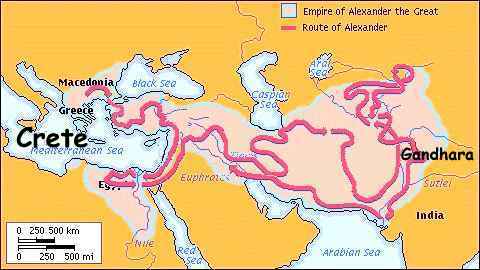
Empire of Alexander the Great
• Alexander
the Great passed through the area of the Kalash Valleys
in 327 B.C. The Kalash's mythological/ religious system is still
very similar to the old Greek. Some of the 16.000 West-Cretan archers
who helped Alexander, led by the Captain and Cretan Admiral Nearchos
stayed behind in this nowadays part of Pakistan and very much influenced
the people of this remote area. You can still have a Tzaziki in
Pakistan!
Alexander conquered/ traded the kingdom of Gandhara for 120
elephants, where his eastbound expedition ended. This kingdom was
well known in those days for its fine art and knowledge. It was
also a religious center.Like this the famous 'Gandhara art'
was born: a mixture of Greek and 'Indian' art. There are still many
samples of statues from this nowadays region of Pakistan, showing
Indian people with charateristic faces and hand gestures, wearing
Greek togas. Since Gandhara was a buddhist center for long, even
nowadays you can find Buddha figures even in Lhasa, the capital
of Tibet, wearing a Greek robe!
Nearchos was born 356 BC. He was a friend and an admiral of Alexander the Great (one of his seven fellow students). He took part at the conquer of India and was Chief of two of them : A land expedition lasting 10 months, between June 327 BC and April 326 BC, started at Zariaspa - Bactria. A fluvial one, of 17 months duration, from April 326 BC. He became Alexander´s admiral, till August 325 BC. The destination of this expedition was the Indus river delta. The fleet consisted of 2000 ships. After exploring the mouth of the Indus river he arrived at the Indian Ocean and continued the travel with 150 ships and 4000 sailors who mostly came from the Aegean Islands. He started from the city of Pattala at the Indus´ delta on 20 September 325 BC and arrived at a close gulf which he named "Alexander´s port", close to today´s city of Karachi. In his honour a moon crater was named Nearchos.
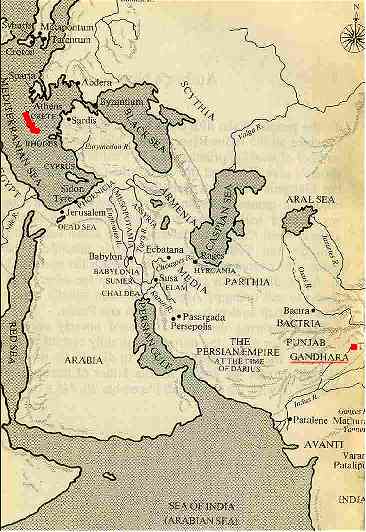
Map of Gandhara
• Alexander bade
farewell to Europe in the spring of the year 334 B.C. Seven years
later he reached India. In the meantime he had destroyed Phoenicia,
the old rival of the Greek merchants. He had conquered Egypt and
had been worshipped by the people of the Nile valley as the son
and heir of the Pharaohs. He had defeated the last Persian king--he
had overthrown the Persian empire he had given orders to rebuild
Babylon--he had led his troops into the heart of the Himalayan mountains
and had made the entire world a Macedonian province and dependency.
Then he stopped and announced even more ambitious plans. The newly
formed Empire must be brought under the influence of the Greek
mind. The people must be taught the Greek language--they must
live in cities built after a Greek model. The Alexandrian soldier
now turned school-master. The military camps of yesterday became
the peaceful centres of the newly imported Greek civilisation. Higher
and higher did the flood of Greek manners and Greek customs rise,
when suddenly Alexander was stricken with a fever and died in the
old palace of King Hammurabi of Babylon in the year 323. Then the
waters receded. But they left behind the fertile clay of a higher
civilisation and Alexander, with all his childish ambitions and
his silly vanities, had performed a most valuable service.
His Empire did not long survive him. A number of ambitious generals
divided the territory among themselves. But they too remained faithful
to the dream of a great world brotherhood of Greek and Asiatic
ideas and knowledge. They maintained their independence until
the Romans added western Asia and Egypt to their other domains.
The strange inheritance of this Hellenistic civilisation (part Greek,
part Persian, part Egyptian and Babylonian) fell to the Roman conquerors.
During the following centuries, it got such a firm hold upon the
Roman world, that we feel its influence in our own lives this very
day.
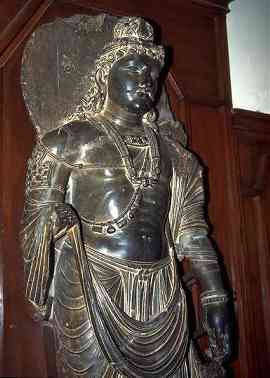
Gandhara art
• The Kalash Valleys lie somewhat to the South of Chitral in Pakistan. The Kalash people are said to be descendants of the troops of Alexander the Great. They are of an Indo-Aryan origin with a language and culture quite distinct from other people in the region. The Kalash have a nature-oriented religion in a largely Muslim country. Their religion is polytheistic with a single creator called Dezau or Khodai and a whole range of lesser gods and spirits. There are only about 3000 Kalash left, living in the Bumburet and a few neighbouring valleys bordering Afghanistan. The Kalash are threatened in their existance by mingling with the rest of the population and a gradual islamisation.
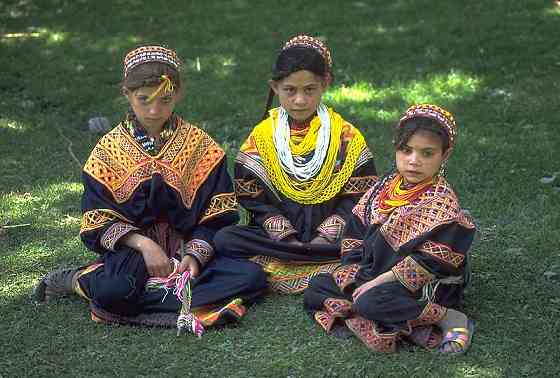
Kalash girls in their traditional attire
• In 140 BC Demetrios with a mercenary army of Cretan ruffians under a pirate, Lasthenes, retook Babylon.
• The followers of Moses finally after many years of wandering came to a land which seemed pleasant and prosperous. It was called Palestine, which means the country of the "Pilistu", the Philistines, a small tribe of Cretans who had settled along the coast after they had been driven away from their own island.
• Letters found in Mari on the Euphrates refer to the products of Cretan metalworkers.
• According to Homer, in the Trojan War Idomeneus led the Cretans from the island of ninety or a hundred cities.
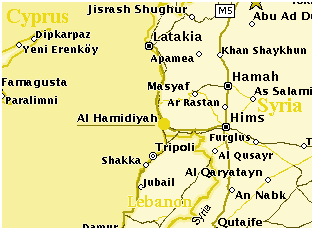
Al Hamidiyah
• A tour to Hamidie
(Al Hamidiyah), named after the Ottoman Sultan Abdul Hamid II, end
last century, may not be included in your visit to Syria, a
country replete with ancient Greek monuments. However, a visitor to
Hamidie will be happily surprised to hear the Cretan dialect
spoken by the residents of this Syrian village. The Hamidians speak
the Cretan dialect in its unadulterated form, as it was spoken on
Crete during the last century. They are very hospitable and friendly
while the elders do not hesitate to relate the circumstances that
forced them out of Crete at the end of the 19th century. Although
natives of Crete, they had been forced to adopt the Muslim religion.
However, this did not prevent them from joining the cause of their
Christian compatriots against Turkish occupation of the island. The
Hamidians love Crete. You can see it in the spark of their eyes when
they speak of Crete. It comes as no surprise then that they have remained
faithful to the Cretan customs and language. Occasionally, Hamidians
employed on fishing boats come to Crete, to return to Hamidie, where
they rekindle the love for the land of their forefathers.
Is it a coincidence that olives may have been cultivated independently
in two places, Crete and Syria? Archeological evidence suggest that
olives were being grown in Crete as long ago as 2500 B.C. From Crete
and Syria olives spread to Greece, Rome and other parts of the Mediterranean
area. (source: STIGMES, the magazine of Crete)
• The presence of Greeks, the so called Pontian Greeks, at the Euxeinos Pontos, the Black Sea, dates back to early times. Research suggests that in the period around 1000 BC first trading adventures in this area took place, searching mainly for gold and minerals. The trip of Jason and the Argonauts to Kolchis, the adventures of Ulysses in the country of the Cimmerians, the punishment of Prometheus by Zeus and the arresting of his body to the mountains of Caucasus, the sailing of Hercules on the Black Sea and other Greek myths related to this area, testify the existence of ancient trading routes. In the 8th century BC, the only occasionally occupied trading posts began to develop into permanent settlements. The town of Miletus was the first to start its colonization politics at the Black Sea by founding its daughter-city Sinope that proved to have great advantages with its useful harbor and its accessibility towards the hinterland. In a similar pattern numerous cities with large populations emerged in the course of time, strong centers with important sea trade and strong cultural influence. Archaeological excavations and plenty of written sources of the classical and post-classical period have unveiled interesting testimonies about the organization of these settlements, of their economic activities and of the trade and political relations with their colonial mother-cities, with other Greek cities and also with indigenous people. In the first centuries of their existence the colonies remained in the same patterns of social and political organisation as their colonial mother-towns. The predominance of the Greek cities in the political life of the region becomes apparent by the reaction of the local people who took over Greek culture and Greek thinking out of their own will. In the period of Alexander the Great and his successors, the economic power of the Greek cities peaked. The impact of the Greek culture on the indigenous people remained strong and helped to develop their social and cultural systems. Under the reign of the Pontian king Mithridates VI Eupator, the Greek language became official language of the many and therefore polyglot people of Asia Minor.
• The fall of Constantinople (1453) and, eight years later of Trebizond (1461) mark one of the greatest fractures in Greek history. Immediately after the seize of Trebizond by the Ottomans, many inhabitants of the rich coastal towns and the villages fled. Most of them escaped into the remote mountain regions of Pontos. Here, out of the sight of the new rulers, they founded new villages and cities, a new and free Greek civilization. However, part of the refugees settled in central Russia, at the coasts of southern Russia, in the region of Georgia, Armenia and Kazakhstan, where they founded new Greek cities, cultural centers, to which persecuted Greeks were gracefully received also in later years.
• Would you ever have suspected that from the 19th to the mid-20th century a Greek firm, Ralli Brothers, controlled the lion's share of the import-export business in the Indian subcontinent? More even than the British East India Company. And that there were substantial Greek communities in the main cities of Calcutta, Bombay, Madras and Karachi?