

The weather in Crete
Weather and temperature information for Sfakia, Crete and Greece
The weather and climate in Crete:
- • Summer lasts for 6 months
- • 'Winter' for only 2 months
- • The remaining 4 months are divided between spring and fall
- • The pleasant climate of Crete provides sunshine for more than 2800 hours/ year.
Greece has a wide range of climate types, ranging from the semi-arid, semi-desert climate of south-eastern Crete to the cold, humid continental climate of Rhodope.
Vegetation and variations in climate are dependent on geographical regions. The multiplicity of plants is exceptional with some 6000 indigenous species having been recorded so far. Over 250 of these flourish in Crete alone. This impressive abundance of flora and fauna arises from Greece's unique geographical location between Europe and Africa and the specific climate of this region, affected by the mountain range crossing the island from east to west and dividing Crete in a northern, typical Mediterranean climate area, and a southern, almost subtropical one.
Higher in the mountains the climate is mountainous. Thus, for instance in Imbros gorge, south-west Crete (Sfakia), one starts at the top with a mountain climate, half way the gorge it's Mediterranean and at the bottom boarding the Libyan Sea subtropical. Flora has adapted itself to this situation, so a wide variety can be found.
Over the year the weather in (South) Crete can be characterised like this:
- • March and April: early Spring, with unstable weather. It can be rainy and windy, but also sunny and warm. Temperatures on Crete range from 14 to 25° C
- • May and early June: full Spring, with usually sunny weather and some short rain showers. Temperatures range from 25° C early May until low thirties in June. This period is great for outdoors activities, like walking and mountain hiking, or for sunbathing and swimming
- • Late June until mid September: full summer, no rain, temperatures in the thirties Celsius. Also in the nights temperature may well stay above 30° C. Winds on the islands, such as Crete, well contribute to the experience of temperature: late afternoon there might be a cooling breeze. More about the winds on Crete here
- • Mid September to late October: like Spring again. High twenties Celsius, an occassional rain shower or some clouds. The second period of the year suitable for walking, but also for the beach
- • Late October to early January: unstable Autumn weather, ranging from sunny and warm days with about 25° C to some rainy, cloudy and windy days with 16° C. It might be possible to comfortably swim in the sea until early January, since the water still is warm. See also our daily winter report 2002 - 2003
- • Early January until mid March: more rain and wind, sometimes very sunny. Temperatures from 10 - 20° C.
South Crete has a warmer climate than North Crete: higher temperatures, less wind and less rain
Please note the above description is a general weather impression. Actual conditions may vary from day to day.
The Greek names for the seasons:
- • Ánixi (=Spring)
- • Kalokéri (=Summer)
- • Fthinóporo (=Autumn)
- • Ximónas (=Winter)
Weather Station Chania provided by National Observatory of Athens |
 |
 |
| Weather Station Vrysses provided by National Observatory of Athens |  |
 |
| Weather Station Samaria gorge provided by National Observatory of Athens |  |
 |
| Weather
Station Paleochora provided
by National Observatory of Athens Supervised by Municipality of Pelekanos |
 |
 |
| Current temperature Chania, Crete |  |
|
| Sun and Moon in West Crete |  |
|
| Current Weather Conditions for Chania airport | Current Weather Conditions for Chania airport, very detailed | |
| Weather reports all over Crete | 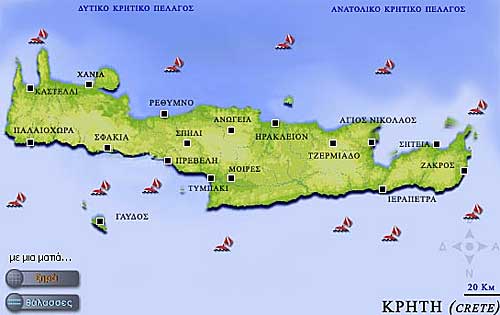 |
|
| Weather forecast for Sfakia (use at one's own risk) | 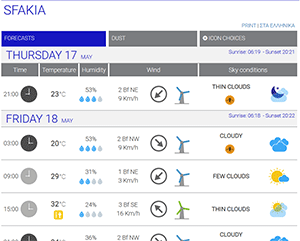 |
|
| Weather forecast for Sfakia 2 (use at one's own risk) | 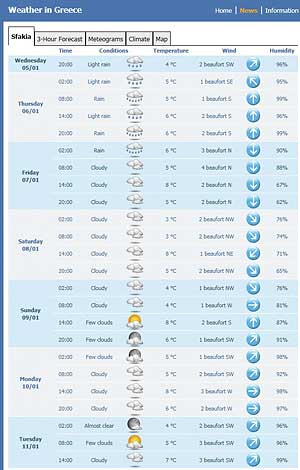 |
|
| Current Weather & forecast for Sfakia 3 (use at one's own risk) | 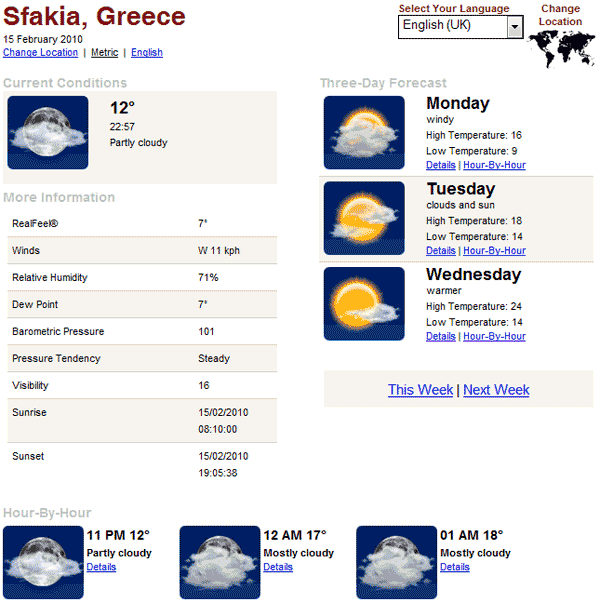 |
|
| Weather Alarm for Greece | 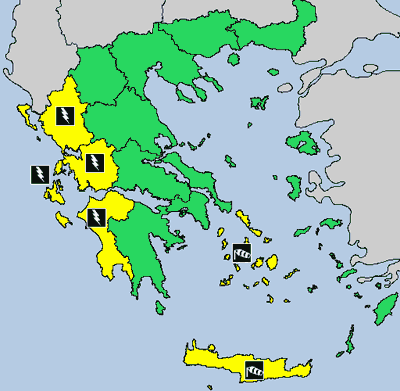 |
|
| Hellenic National Meteorological Service | 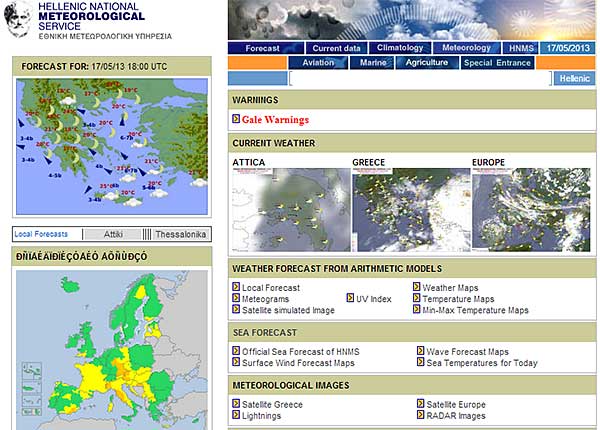 |
|
| Cloud coverage Europe | 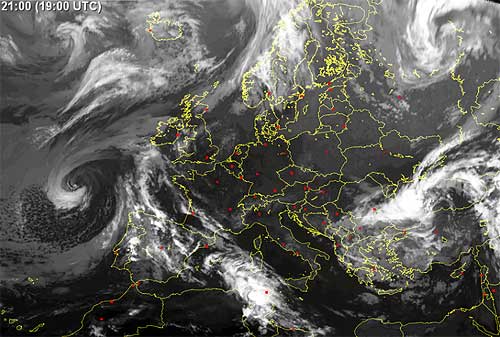 |
|
| Cloud coverage Greece and Crete animated | 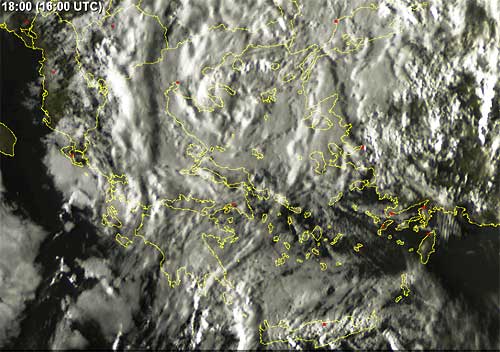 |
|
| Monthly climatological data Paleochora, southwest coast Crete | Click for monthly data |
Monthly report for Chora Sfakion, southwest Crete
| Month | Av.Temp.
in C (max-min) |
Av.Temp.
Water in C |
Sunshine
Hrs |
Rainy days |
| January | 17,2 - 8,8 | 16 | 4,3 | 6 |
| February | 16,7 -9,1 | 15 | 4,9 | 7 |
| March | 17,3 - 9,8 | 16 | 5,9 | 8 |
| April | 20,1 - 13,6 | 17 | 8,8 | 6 |
| May | 26,7 - 17,9 | 20 | 10,8 | 2 |
| June | 29,5 - 20,3 | 23 | 11,9 | 1 |
| July | 31,2 - 22,9 | 25 | 13,6 | 0 |
| August | 31,4 - 23,1 | 26 | 12,8 | 1 |
| September | 27,8 - 21,1 | 26,5 | 11,4 | 1 |
| October | 26,7 - 17,6 | 24 | 9,5 | 4 |
| November | 23,1 - 14,2 | 22 | 7,5 | 4 |
| December | 17,9 - 11,7 | 18 | 5,5 | 8 |
© Hotel Stavris, Chora Sfakion, Crete, Greece. Source: 1999, our own measurements
Extreme temperatures in Crete over the past 300 years:
- • minimum: -1° C
- • maximum: +48° C
Monthly averages for Chania city: click here
Click below for updated weather info (meteo Crète)
| Other side of the Libyan Sea: Tobruk, Libya, directly opposite of Chora Sfakion. The actual weather in Sfakia is between the observations of Souda, Chania and Tobruk. With winds from the north, Sfakia is warmer, from the south Tobruk. | 
|
| Poseidon: Greek weather forecast: many detailed options |  |
| University of Athens Many detailed forecasts |  |
| Cloud coverage Europe |  |
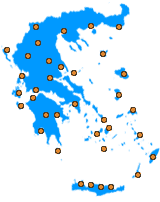
| National
Observatory of Athens: Daily forecasts
are issued for Europe, Greece and Athens area by two models: BOLAM and
MM5. Detailed forecasts are issued for 40 major Greek cities, as well as for selected locations over the Greek seas (sailing forecasts). Forecasts are presented as maps, time-plots, word text and outlook tables. Surface observations over Europe and Greece, satellite pictures, satellite winds and sferics are also presented. |
 |
| Surface observations over Greece: The most recently observed weather conditions for Greece are available here. Select a location from the map to display the latest observation from that location | 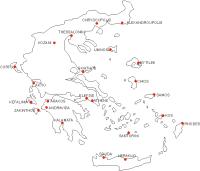 |
| Moving weather map for Europe |  |
| Historical weather averages for Timbaki, South Crete, with 39 years of reports in the database |  |
Watch our slideshow of the entire 2013 weather season, from the beach webcam in Chora Sfakion, Crete:
Play in large player on 720p HD high resolution
Watch our slideshow of the entire 2014 weather season, from the beach webcam in Chora Sfakion, Crete:
Play in large player on 720p HD high resolution
Watch our slideshow of the entire 2015 weather season, from the beach webcam in Chora Sfakion, Crete:
Play in large player on 720p HD high resolution
Watch our slideshow of the entire 2016 weather season, from the beach webcam in Chora Sfakion, Crete:
Play in large player on 720p HD high resolution
Watch our slideshow of the entire 2017 weather season, from the beach webcam in Chora Sfakion, Crete:
Play in large player on 720p HD high resolution