

Part 1 | Part 2 | Part 3 | Part 4
History of Sfakia - part 4
At the crossroads of traffic between Europe, Asia and Africa
MODERN YEARS (1898 - until today)
In 1898, the Great Powers declared Crete as "an independent Cretan State", under the rule of the Sultan. Yet, the administration of commander Prince George irritated the Cretans, who in 1905 revolted - the famous "Revolution of Theriso" -, thus forcing Prince George to resign and appoint commandeer, Alexandros Zaimis. This is when Eleftherios Venizelos, the greatest politician in Greece, sealed the history of Modern Greece. During 17-30 May 1913 the final union of Crete with Greece ("Enosis") was signed and the Greek flag was installed in Crete.
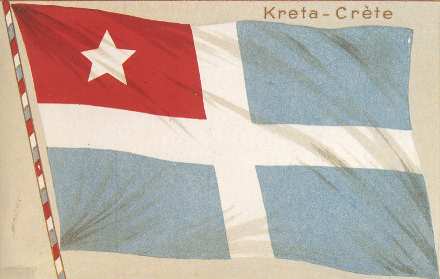
Flag of independent Crete 1898 - 1913
It was universally hated on the island. The star in top left hand corner was supposed to appease the Muslims on the island (Muslims were subsequently removed from Crete during the exchange of populations - Muslim for Christian - between Greece and Turkey in 1923; a practice now called "ethnic cleansing") and the Christians, who had hoped for "enosis" (or unification) with Greece.
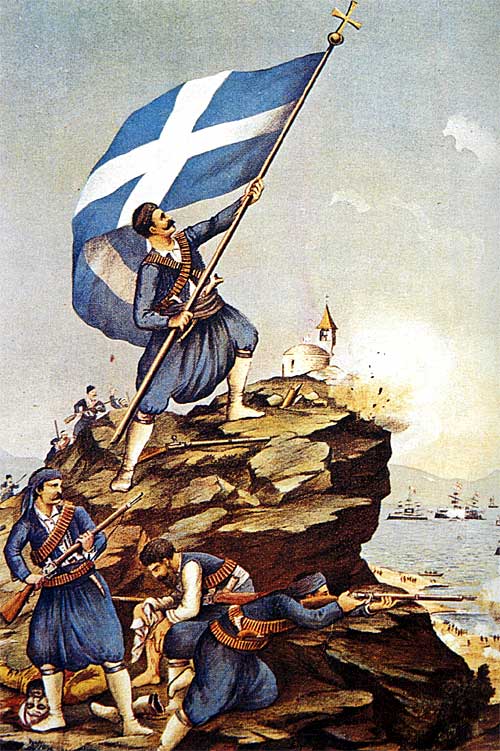
Original flag of Greece
This attempt at appeasement spectacularly backfired. The Muslims felt that it showed that they were a minority (you'll see from the flag that it's obsensibly the Greek flag of that time, with a quarter representing the Muslim minority) and the Christians just didn't want to be reminded of the Ottoman empire in their own flag. The "Great powers" that were, (Britain, France and Russia), didn't listen and this flag was officially the Cretan flag for 15 years, though there were various other flags and emblems used during that period.
Even now, some 100 years after unification with Greece, Cretans don't like to be reminded of that flag, and who can blame them?
Thanks to Stelios Jackson, Hellenic Bookservice, UK
During the German occupation, the Cretans fought for their liberation, the most known being the battle of Crete, dated 20-28 May 1941, when the most important German landing was rebuked by the Cretans and the Allies: Australians, New Zealanders and British.
Of the 50,662 allied troops embarked from Greece, about 30,000 were landed in Crete, without most of their vehicles and heavy weapons. On 30 April, General Freyberg was given command of all the allied forces on the island with orders to defend it against a probable attack by German airborne troops. After some men were shipped to Egypt, Freyberg was west with a force of 15,000 British, 7,700 New Zealand, 6,500 Australian and 11,000 Greek troops. The Australian forces comprised five infantry battalion (2/1st, 2/4th, 2/7th, 2/8th and 2/11th) all much below strength. In addition there were portions of other units such as the 2/1st Machine Gun Battalion, 2/2nd and 2/3rd Field Regiments and the 2/8th Field Company. Most of these were assigned infantry tasks. Since Allied Intelligence had reported the invasion would take place from the air, General Freyberg had disposed his forces with that in view. They occupied four main sectors - the towns of Rethimo, Chania and Heraklion and the vital port of Souda at the head of Souda Bay on Crete's northern coast. The force was gravely short of equipment and after the systematic heavy bombing by the Germans there were only six British aircraft still serviceable and they were flown to Egypt.
The German plan, Operation Mercury, was to capture Crete with airborne troops with a glider regiment and a parachute regiment to land at Maleme and Chania on the morning of the 20 May. These troops were to be followed in the afternoon by two parachute battalion at Rethimo and four at Heraklion. Additional troops would come from a mountain division which was to be partly landed on captured airfields with the remainder taken to Crete by sea. The initial German airdrop on Maleme suffered heavy casualties but further landings in the open country to the west provided sufficient forces for the Germans to capture Maleme airfield. The runway was only some 2000 feet long but its capture by the Germans was essential to the success of its operation and they were able to hold onto to it despite strong New Zealand counter-attacks. The loss of Maleme airfield threatened the whole allied position in Crete since the Germans, with air-superiority, were able to bring in reinforcements and supplies.
Despite Australian success at Rethimo and Heraklion, German pressure continued to rise and on 27 May 1941 General Wavell ordered allied forces to abandon the island. The 2/4th Australian Battalion, at Heraklion was the first to leave. They boarded the cruisers Orion and Dido and the destroyers Hereward, Hasty, Havoc, Imperial, Hotspur and Jackal. During the 350 mile trip these ships were under constant attack from waves of German Stukas. About 600 men were killed including 48 Australians. After that, the naval authorities decided there was no hope of lifting troops from Chania, Souda Bay and Rethimo.
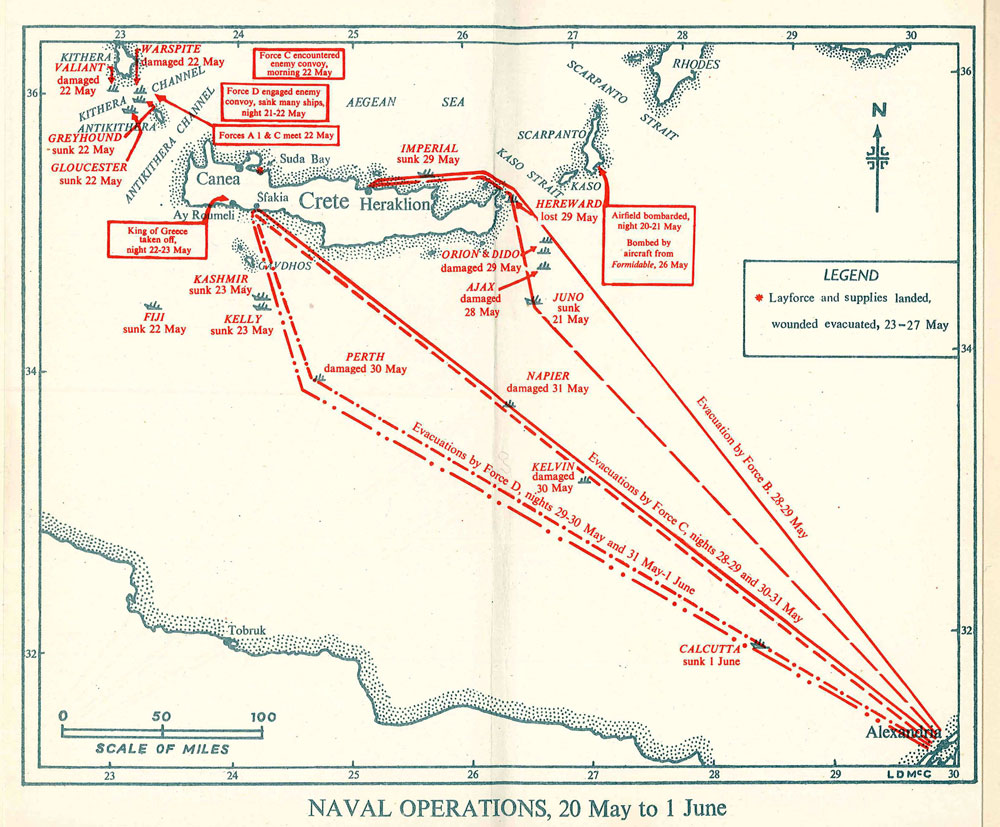
British naval operations around Crete, 20 May - 1 June 1941
The forces were ordered to fight their way out of the towns and strike across the island to the village of Sfakia where the navy would meet them on 31 May. About 15,000 men were embarked from Sfakia and Heraklion with about 12,000 being taken prisoner. The Germans lost some 4,000 men killed and 2500 wounded on Crete. Australian losses on Greece were 320 killed, 494 wounded and 2000 captured. On Crete, 274 Australians were killed, 507 were wounded and 3100 were captured including most of the 2/1st, 2/7th and 2/11th Battalions. New Zealand losses for Greece and Crete were 962 killed, 2000 wounded and over 3000 captured.
After the four years of German occupation, a period of peace and healing began for the Cretans. From that point on the island flourished, thanks to agriculture and in recent years, tourism.
The Greek War of Independence from the Ottoman Empire began in 1821 and concluded with the winning of independence in 1830. With the support of England, France, and Russia, a monarchy was established. A Bavarian prince, Otto, was named king in 1833. He was deposed 30 years later, and the Great Powers chose a prince of the Danish House of Glucksberg as his successor. He became George I, King of the Hellenes.
The Megali Idea (Great Idea), a vision of uniting all Greeks of the declining Ottoman Empire within the newly independent Greek State, exerted strong influence on the early Greek state. At independence, Greece had an area of 47,515 square kilometers (18,346 square mi.), and its northern boundary extended from the Gulf of Volos to the Gulf of Arta. The Ionian Islands were added in 1864; Thessaly and part of Epirus in 1881; Macedonia, Crete, Epirus, and the Aegean Islands in 1913; Western Thrace in 1918; and the Dodecanese Islands in 1947.
Greece entered World War I in 1917 on the side of the Allies. After the war, Greece took part in the Allied occupation of Turkey, where many Greeks still lived. In 1921, the Greek army attacked from its base in Smyrna (now Izmir), and marched toward Ankara. The Greeks were defeated by Turkish forces led by Mustafa Kemal (later Ataturk) and were forced to withdraw in the summer of 1922. Smyrna was sacked by the Turks, and more than 1.3 million Greek refugees from Turkey poured into Greece, creating enormous challenges for the Greek economy and society and effectively ending the Megali Idea. Greek politics, particularly between the two world wars, involved a struggle for power between monarchists and republicans. Greece was proclaimed a republic in 1924, but George II returned to the throne in 1935, and a plebiscite in 1946 upheld the monarchy. It was finally abolished, however, by referendum on December 8, 1974, when more than two-thirds of the voters supported the establishment of a republic.
Greece's entry into World War II was precipitated by the Italian invasion on October 28, 1940. That date is celebrated in Greece by the one-word reply--ochi ('no')--symbolizing the Greek Prime Minister's rejection of the surrender demand made by Mussolini. Despite Italian superiority in numbers and equipment, determined Greek defenders drove the invaders back into Albania. Hitler was forced to divert German troops to protect his southern flank and attacked Greece in early April 1941. By the end of May, the Germans had overrun most of the country, although Greek resistance was never entirely suppressed. German forces withdrew in October 1944, and the government in exile returned to Athens. After the German withdrawal, the principal Greek resistance movement, which was controlled by the communists, refused to disarm. A banned demonstration by resistance forces in Athens in December 1944 ended in violence and was followed by an intense, house-to-house battle with Greek Government and British forces. After 3 weeks, the communists were defeated and an unstable coalition government was formed.
Continuing tensions led to the dissolution of that government and the outbreak of full-fledged civil war in 1946. First the United Kingdom and later the U.S. gave extensive military and economic aid to the Greek Government. Communist successes in 1947-48 enabled them to move freely over much of mainland Greece, but with extensive reorganization and American material support, the Greek National Army was slowly able to regain control over most of the countryside. Yugoslavia closed its borders to the insurgent forces in 1949, after Marshal Tito of Yugoslavia broke with Stalin and the Soviet Union. In August 1949, the National Army under Marshal Alexander Papagos launched a final offensive that forced the remaining insurgents to surrender or flee across the northern border into the territory of Greece's communist neighbors. The insurgency resulted in 100,000 killed and caused catastrophic economic disruption. In addition, at least 25,000 Greeks were either voluntarily or forcibly evacuated to Eastern Bloc countries, while 700,000 became displaced persons inside the country. After the 1944-49 Greek civil war, Greece sought to join the Western democracies and became a member of NATO in 1952.
From 1952 to late 1963, Greece was governed by conservative parties -- the Greek Rally of Marshal Alexandros Papagos and its successor, the National Radical Union (ERE) of Constantine Karamanlis. In 1963, the Center Union Party of George Papandreou was elected and governed until July 1965. It was followed by a succession of unstable coalition governments.
On April 21, 1967, just before scheduled elections, a group of colonels led by Col. George Papadopoulos seized power in a coup d'etat. Civil liberties were suppressed, special military courts were established, and political parties were dissolved. Several thousand political opponents were imprisoned or exiled to remote Greek islands. In November 1973, following an uprising of students at the Athens Polytechnic University, Gen. Dimitrios Ioannides replaced Papadopoulos and tried to continue the dictatorship. Gen. Ioannides' attempt in July 1974 to overthrow Archbishop Makarios, the President of Cyprus, brought Greece to the brink of war with Turkey, which invaded Cyprus and occupied part of the island. Senior Greek military officers then withdrew their support from the junta, which toppled. Leading citizens persuaded Karamanlis to return from exile in France to establish a government of national unity until elections could be held. Karamanlis' newly organized party, New Democracy (ND), won elections held in November 1974, and he became Prime Minister.
Following the 1974 referendum which resulted in the rejection of the monarchy, a new constitution was approved by parliament on June 19, 1975, and parliament elected Constantine Tsatsos as President of the republic. In the parliamentary elections of 1977, New Democracy again won a majority of seats. In May 1980, Prime Minister Karamanlis was elected to succeed Tsatsos as president. George Rallis was then chosen party leader and succeeded Karamanlis as Prime Minister. On January 1, 1981, Greece became the 10th member of the European Community (now the European Union). In parliamentary elections held on October 18, 1981, Greece elected its first socialist government when the Panhellenic Socialist Movement (PASOK), led by Andreas Papandreou, won 172 of 300 seats. On March 29, 1985, after Prime Minister Papandreou declined to support President Karamanlis for a second term, Supreme Court Justice Christos Sartzetakis was elected president by the Greek parliament. Greece had two rounds of parliamentary elections in 1989; both produced weak coalition governments with limited mandates. Party leaders withdrew their support in February 1990, and elections were held on April 8. In the April 1990 election, ND won 150 seats and subsequently gained 2 others. After Mitsotakis fired his first Foreign Minister--Andonis Samaras--in 1992, Samaras formed his own political party, Political Spring. A split between Mitsotakis and Samaras led to the collapse of the ND government and new elections in September 1993. On January 17, 1996, following a protracted illness, Prime Minister Papandreou resigned and was replaced as Prime Minister by former Minister of Industry Constantine Simitis. In elections held in September 1996, Constantine Simitis was elected Prime Minister. PASOK won 162 seats, New Democracy 108.
2015
These are the participants in the Greek elections of 25 January, 2015

The Greek elections on Sunday, 25 January are important not only for Greece but also for the eurozone. The outcome is therefore eagerly awaited. The far-left party SYRIZA is the intended and simultaneously dreaded winner. Who else participate? An overview.
SYRIZA
SYRIZA was established ahead of the Greek elections in 2004. It is an amalgamation of eleven leftist groups, inter alia, Marxists, socialists, Maoists and green ranks.
The party runs on top with an expected 33.8 percent of the votes in the polls. It owes much of its popularity to the charismatic leader Alexis Tsipras, in Greece known as "sexy Alexi".
With his youthful appearance, wavy dark hair and slim stature he exercises the necessary attraction to women. But also men can appreciate his sprawl. Tsipras rarely wears a tie, wants to be called with his first name, and moves around on a motorcycle.
In Brussels Tsipras is much less popular. His party goals make many Commissioner tremble. He wants to stop the imposed cuts, drop a large portion of the Greek debt and nationalise banks. He also calls for an increase of the minimum wage.
Tsipras has often aimed at leaving the euro zone, but as the party gets closer to power (SYRIZA won the European elections in May) he moderates his tone. In the current party programme it says that Greece must stay in the eurozone.
NEA DIMOKRATIAThe leader of Nea Dimokratia (New Democracy), Antonis Samaras (63), was at its seventeenth tennis champion. He comes from a wealthy family and shared in his younger years a student flat with Georgos Papandreou, former leader of PASOK, with which his party is in the government.
New Democracy holds 91 of the 300 seats and sails a conservative course. It sets itself up as the guardian of the private sector. The focus of the party is on the recovery of the economy. In other words, the creation and protection of jobs.
Samaras, once a staunch critic of neo-liberal policies, will do anything to keep his country in the eurozone. He clings to the austerity measures imposed by the EU and IMF.
The rise of SYRIZA is for Samaras an eyesore. He sees the party as a communist stronghold. "A mistake" which ought not to be made in Greece, as he once said during a speech.
In the polls New Democracy stands on 28.6 percent of the votes.
PASOKThe Greek socialist party was founded in the seventies against the dictatorship of the military junta. Over the past forty years, PASOK dominated politics. Party leader George Papandreou was Greece's prime minister from October 2009 to November 2011. He comes from a well known family: his grandfather was a celebrated socialist politician, his father established PASOK.
The party has since two years a new leader: Evangelos Venizelos. Which is not there for nothing. When Greece drifted into an economic crisis, PASOK insisted on massive cuts. That did not sit well with the population. Papandreou was forced to resign and the party plummeted in the polls. These elections will probably end in a fiasco again. The counter is at 4.2 percent.
Venizelos can count on the support of the unions and center-left voters, but is also notorious for his role in the preparations for the Athens Olympics in 2004. The project was financially completely out of control. An enormous amount of state money has been invested.
CHRYSI AVGIThe far-right party Golden Dawn is at 4.9 percent, slightly higher in the polls than PASOK. And that is remarkable, as party leader Nikolaos Michaloliakos stays in prison. Along with other members of his party he is accused of extortion, possession of weapons and leading a criminal gang.
Supporters of the Golden Dawn often lay about immigrants with the fists. Illegal immigrants, as party leader Michaloliakos says, can best can be combated with landmines.
It is one of his many controversial statements. Another: the gas chambers at Auschwitz never existed.
The Golden Dawn is primarily an anti-party. It is against the political order, against imposed cuts and against immigrants who settle in Greece.
TO POTAMIPolitical newcomer To Potami (meaning "the river" ) was established in March 2014 by the prominent television journalist Stavros Theodorakis. He is a true pro-European. Greece should, according to the party, strictly adhere to the austerity program. The country must at all costs remain within the eurozone.
Theodorakis wants not only to create jobs, he also wants to tackle corruption. Cooperation with SYRIZA he does not exclude. His party may serve as a "third party" in parliament, he suggests himself. Given the polls (5.9 percent) this could work like this.
KKEThe oldest participant in the elections is the Communist Party. The communists have been running since 1918. During World War II, the party played a major role in the resistance against the Nazis. The current leader, Dimitris Koustoumpas, clings to Marxist ideology and is especially popular among the working class in the industrial areas of Greece.
Supporters of the Communist Party led the way in the protests against the cuts.
The party stands at 4.3 per cent in the polls.
OTHERSAt the bottom in the polls are dangling some small parties. This includes the Movement of Democratic Socialists ["Kinima", Kinima Dimokraton Sosialiston] (2.1 percent), founded by former Prime Minister George Papandreou. He promised "a new era": progressive, proper attention to climate change and other environmental issues.
The Independent Greeks (3.1 percent), led by Panos Kammenos, are a splinter party of New Democracy. Founded in 2012. It is a center-right party that is aligned in terms of ideas about budget cuts with SYRIZA.
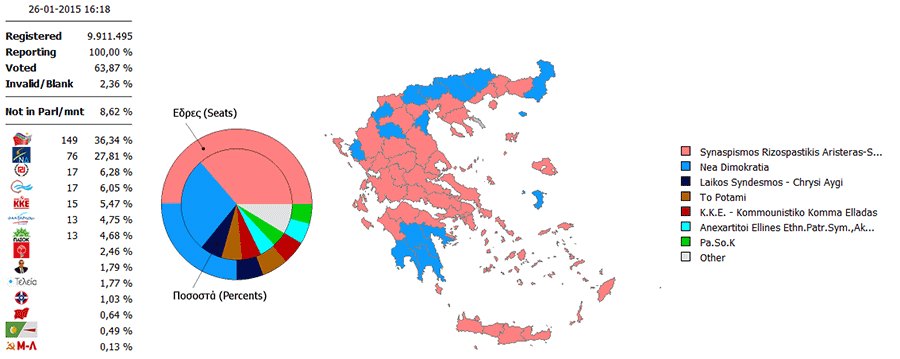
Final results Greek elections 25 January, 2015
SYRIZA gained a historic victory in the parliamentary elections in Greece on 25 January, 2015. They formed a coalition government with The Independent Greeks, with Alexis Tsipras as the new Prime Minister.
You can read more news about the history and archaeology of Crete on our History and Archaeology of Crete Forum